Veeam Completes Acquisition of Securiti AI to Create the Industry’s First Trusted Data Platform for Accelerating Safe AI at Scale

View

Why DSPM? Top 6 Cloud Data Security Challenges Solved

Author

Nikhil Girdhar

Senior Director for Data Security products at Securiti.

Listen to the content

This post is also available in: Arabic

Enterprise security teams need to safeguard their data at scale to minimize risk and meet regulatory compliance — and that can be a tall order as data in the cloud becomes more voluminous and complex. Plus, the emergence of gen AI technologies onto the global “datasphere” ups the ante, increasing the urgency, complexity, and unpredictability of many data security challenges.

Security teams that struggle to navigate the challenges of (1) finding dark and shadow data, (2) discovering blindspots, (3) prioritizing misconfigurations, (4) managing technical controls, (5) ensuring least privilege, and (6) managing breach response in compliance with local and global regulations that are continuously growing in number and complexity can feel like they’re tiptoeing through a landmine of mounting risk. And with the sheer volume of data growing at a rate that increases year over year — and is, in fact, projected to exceed IDC’s 175 ZB prediction by 2025 to reach 181ZB of global data in that time — it can feel like the threats are closing in.

Thankfully, there are technologies to help enterprises map this battlefield of risk, and they begin with data security posture management (DSPM) — an approach to cloud security that goes a long way toward enabling coverage for platform-as-a-service (PaaS) and infrastructure-as-a-service (IaaS) cloud environments, but stops short of protecting data everywhere across the enterprise. Orgs relying exclusively on DSPM run the risk of leaving their on-prem and software-as-a-service (SaaS) systems — as well as data in motion — vulnerable.

Securiti Tops DSPM Ratings

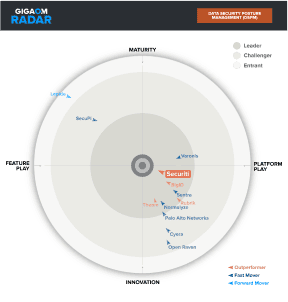
Securiti’s Data Command Center dominates GigaOm’s DSPM Evaluation with highest ratings for key capabilities, #emerging capabilities, and business criteria.

Read the Report
Securiti Tops DSPM Ratings

Take SaaS as an example. It’s not uncommon for an enterprise to have upward of 50 SaaS applications and cloud service providers under their data umbrella. Each would have its own native security controls and features, which, considered individually and provided they are configured correctly, function just fine. But when you have several of them, with varying oversight from security teams, you run into a problem of scale. Add on top of this that these systems are not built to communicate with each other, do not share the same policies and controls, and require an org to have multiple classification taxonomies, labeling policies, security controls, and more.

Here’s a look at some of the top challenges that security teams face in protecting data in the cloud — and beyond.

Finding dark data and shadow data

Think about this: It’s possible — likely, even — that the majority of your enterprise data is dark or shadow data, stored in forgotten systems or accumulating in new ones that have yet to come under security teams’ oversight (we’re looking at you, gen AI models). This could be legacy data that conceals unknown risk, leaves sensitive data vulnerable to breach, and jeopardizes regulatory compliance — or data that contains untold opportunity, ripe for unlocking possibilities. Either way, you need to gain full visibility into it to minimize risk to your org.

One-third of enterprises say that 75% or more of their organization’s data is dark data — or data that has been collected over time that no one is monitoring, is not a business asset, and could pose an embarrassing risk to the enterprise if compromised. Depending on the industry, anywhere from 40% to 90% of an organization’s data might fall under this category.

When it comes to shadow data — data that is being created, stored, and even shared without security controls or policies in place — 60% of orgs estimate that over half of their data is unknown to their security and IT teams. If it’s not monitored, it’s more vulnerable to unauthorized access.

Both dark and shadow data leave enterprises open to risk, vulnerable to attack, and in breach of multiple compliance regulations.

Discovering blindspots

Just because you know where your data is doesn’t mean that you have the visibility into it that you need. Data that falls into a company’s blind spot may contain sensitive information that poses a risk to the organization, from personal information (PI) and protected health information (PHI) to employee data or company IP.

You can’t protect what you can’t see — or don’t even know you have. You have to find it to know how to safeguard it. Old techniques for data discovery, like manual asset classification, don’t hold up in complex cloud environments. Enterprises need more advanced, modern, machine-learning techniques to address blind spots and gain visibility into all their sensitive data — everywhere.

Prioritizing misconfigurations

It’s no secret that businesses want to move fast to accelerate innovation and maintain a competitive edge — and that teams often find themselves rushed to the point of making mistakes. For this unfortunate reason, configuration errors in cloud services are common. And, while most are avoidable, these settings are not always easy to configure, exacerbating the problem. From rushed development and deployment to out-of-the-box automation to improper encrypting, the causes of these errors are as diverse as they are pernicious, leaving sensitive data in misconfigured systems exposed and vulnerable to unauthorized access.

Security teams — who are themselves just as rushed — are left to catch these mistakes, operationalize a process to prioritize them, and fix them. Businesses need visibility into where their most important data lives so they can manage the configurations of those environments more intelligently.

Managing technical controls

Orgs create policies to manage their data all the time, defining how teams should handle practices like password masking and data encryption, but whether or not these policies are created with best practices in mind — and then properly communicated, implemented, and operationalized across the business — is a different story.

Even with the best policies and practices in place, many security teams still have no way of knowing if other departments and divisions are falling in line with sound data protection practices. To determine whether these (one hopes) carefully constructed and well-intentioned policies are being adhered to past the purview of their own departments, security teams need to gain visibility into all the data within the org.

Ensuring least privilege

Enterprises must govern access to their data estate through the principle of least privilege. A system that surfaces data permissions anomalies and provides methods for remediation is a critical path control that ensures the safety of your data.

The need for convenient access to data for business purposes must be balanced with ensuring the security of that data. Understanding over-privileged users and configurations that allow public or discretionary sharing, plus enabling quick remediation of user data needs, are challenges every enterprise faces. A sophisticated system that understands and contextualizes your entire data estate allows you to maintain this balance and enable your users to be their most productive while preventing unnecessary access in the case that a user’s account is compromised.

Managing breach response

The dreaded data breach incident — or even malicious attack — can happen even to the most conscientious of companies. The measure of your org’s security practices is not necessarily in the compromising of data itself, but in the response to it — including the speed, transparency, and comprehensiveness with which it’s managed. Efficient response management is key for compliance, whereas the alternative can run up detrimental costs for an organization in regulatory penalties, legal settlements and fees, brand reputation, and more.

And while being secure does not necessarily mean being immune to a breach incident, enterprises that prioritize security risks and remediate the highest-level threats and violations first will be in a better position to detect and deflect threats when they arise, as well as handle breaches in an efficient, smooth, compliant manner.

Defaulting to legacy methods of securing data and relying on different sets of policies for various, disparate systems across the enterprise just doesn’t cut it in a world where 329 million terabytes of data are created each day. Using Securiti’s unified Data Command Center, orgs can enable DSPM for their enterprise cloud data — and then go beyond DSPM to protect not just cloud data, but on-prem, SaaS, and data in motion. Standing up a single, centralized source of data truth will allow you to discover dark data at scale across all systems in your enterprise, bring shadow data under your security team’s oversight, pull blind spots into view, better prioritize and manage risk due to misconfigurations, manage user access through a least-privilege lens, and conduct a comprehensive and compliant data breach response if something goes wrong.

5 Steps to AI Governance:

Read the full whitepaper on Securing Sensitive Data at Scale to learn more about how protecting your data across all your environments can unlock better business insights, innovation, and a competitive edge.

Ready for a demo? Get an up-close and personal look at how you can leverage Securiti’s Data Command Center to address data security, privacy, governance, and compliance obligations across hybrid multicloud environments.

Analyze this article with AI

Prompts open in third-party AI tools.
Join Our Newsletter

Get all the latest information, law updates and more delivered to your inbox


Share

More Stories that May Interest You
Videos
View More
Mitigating OWASP Top 10 for LLM Applications 2025
Generative AI (GenAI) has transformed how enterprises operate, scale, and grow. There’s an AI application for every purpose, from increasing employee productivity to streamlining...
View More
Top 6 DSPM Use Cases
With the advent of Generative AI (GenAI), data has become more dynamic. New data is generated faster than ever, transmitted to various systems, applications,...
View More
Colorado Privacy Act (CPA)
What is the Colorado Privacy Act? The CPA is a comprehensive privacy law signed on July 7, 2021. It established new standards for personal...
View More
Securiti for Copilot in SaaS
Accelerate Copilot Adoption Securely & Confidently Organizations are eager to adopt Microsoft 365 Copilot for increased productivity and efficiency. However, security concerns like data...
View More
Top 10 Considerations for Safely Using Unstructured Data with GenAI
A staggering 90% of an organization's data is unstructured. This data is rapidly being used to fuel GenAI applications like chatbots and AI search....
View More
Gencore AI: Building Safe, Enterprise-grade AI Systems in Minutes
As enterprises adopt generative AI, data and AI teams face numerous hurdles: securely connecting unstructured and structured data sources, maintaining proper controls and governance,...
View More
Navigating CPRA: Key Insights for Businesses
What is CPRA? The California Privacy Rights Act (CPRA) is California's state legislation aimed at protecting residents' digital privacy. It became effective on January...
View More
Navigating the Shift: Transitioning to PCI DSS v4.0
What is PCI DSS? PCI DSS (Payment Card Industry Data Security Standard) is a set of security standards to ensure safe processing, storage, and...
View More
Securing Data+AI : Playbook for Trust, Risk, and Security Management (TRiSM)
AI's growing security risks have 48% of global CISOs alarmed. Join this keynote to learn about a practical playbook for enabling AI Trust, Risk,...
AWS Startup Showcase Cybersecurity Governance With Generative AI View More
AWS Startup Showcase Cybersecurity Governance With Generative AI
Balancing Innovation and Governance with Generative AI Generative AI has the potential to disrupt all aspects of business, with powerful new capabilities. However, with...

Spotlight Talks

Spotlight 50:52
From Data to Deployment: Safeguarding Enterprise AI with Security and Governance
Watch Now View
Spotlight 11:29
Not Hype — Dye & Durham’s Analytics Head Shows What AI at Work Really Looks Like
Watch Now View
Spotlight 11:18
Rewiring Real Estate Finance — How Walker & Dunlop Is Giving Its $135B Portfolio a Data-First Refresh
Watch Now View
Spotlight 13:38
Accelerating Miracles — How Sanofi is Embedding AI to Significantly Reduce Drug Development Timelines
Sanofi Thumbnail
Watch Now View
Spotlight 10:35
There’s Been a Material Shift in the Data Center of Gravity
Watch Now View
Spotlight 14:21
AI Governance Is Much More than Technology Risk Mitigation
Watch Now View
Spotlight 12:!3
You Can’t Build Pipelines, Warehouses, or AI Platforms Without Business Knowledge
Watch Now View
Spotlight 47:42
Cybersecurity – Where Leaders are Buying, Building, and Partnering
Rehan Jalil
Watch Now View
Spotlight 27:29
Building Safe AI with Databricks and Gencore
Rehan Jalil
Watch Now View
Spotlight 46:02
Building Safe Enterprise AI: A Practical Roadmap
Watch Now View
Latest
View More
DataAI Security: Why Healthcare Organizations Choose Securiti
Discover why healthcare organizations trust Securiti for Data & AI Security. Learn key blockers, five proven advantages, and what safe data innovation makes possible.
View More
The Anthropic Exploit: Welcome to the Era of AI Agent Attacks
Explore the first AI agent attack, why it changes everything, and how DataAI Security pillars like Intelligence, CommandGraph, and Firewalls protect sensitive data.
HIPAA PHI Explained: Identifiers, De-identification & Compliance Checklist View More
HIPAA PHI Explained: Identifiers, De-identification & Compliance Checklist
Discover what PHI is under HIPAA. Understand what is considered PHI as per HIPAA Rules, the list of 18 identifiers, and what happens to...
Red Teaming View More
What is AI Red Teaming? Complete Guide
AI red teaming tests AI systems for security, safety, and misuse risks. Learn how it works, common techniques, real-world use cases, and why it...
View More
Australia’s Privacy Overhaul: Landmark Reforms in Privacy, Cyber Security & Online Safety
Access the whitepaper and gain insights into Australia’s Privacy Law landscape, CSLP, Social Media Minimum Age Act, and how Securiti helps ensure swift compliance.
View More
CNIL’s €475 Million Cookie Consent Enforcement: Key Lessons for Organizations
Download the whitepaper to learn about CNIL’s €475 million cookie consent enforcement fine. Discover key lessons for organizations and how to automate compliance.
View More
Solution Brief: Microsoft Purview + Securiti
Extend Microsoft Purview with Securiti to discover, classify, and reduce data & AI risk across hybrid environments with continuous monitoring and automated remediation. Learn...
Top 7 Data & AI Security Trends 2026 View More
Top 7 Data & AI Security Trends 2026
Discover the top 7 Data & AI security trends for 2026. Learn how to secure AI agents, govern data, manage risk, and scale AI...
View More
Navigating HITRUST: A Guide to Certification
Securiti's eBook is a practical guide to HITRUST certification, covering everything from choosing i1 vs r2 and scope systems to managing CAPs & planning...
The DSPM Architect’s Handbook View More
The DSPM Architect’s Handbook: Building an Enterprise-Ready Data+AI Security Program
Get certified in DSPM. Learn to architect a DSPM solution, operationalize data and AI security, apply enterprise best practices, and enable secure AI adoption...
What's
New