Announcing Agent Commander - The First Integrated solution from Veeam + Securiti.ai enabling the scaling of safe AI agents

View

Risk Silos: The Biggest AI Problem Boards Aren’t Talking About

Author

Cassandra Maldini

VP AI Governance & Privacy

Listen to the content

Boards are tuned in to the AI conversation, but there’s a blind spot many organizations still haven’t named: risk silos.

Everyone agrees AI governance matters. That’s not up for debate. The issue is that if you ask five professionals from the same company—legal, privacy, security, data governance, and IT—what “AI governance” means, you’ll get five different answers. That confusion isn’t harmless. It’s the origin story of risk silos.

The Hidden Cost of “Working in Parallel”

Companies love to showcase their commitment to responsible AI and EU AI Act readiness. But until teams are aligned on what AI governance actually means and how to execute it together, they’re spinning in circles, duplicating work, and draining resources.

Picture this:

  • Security is chasing ISO 42001 and AI Act compliance.
  • Privacy is buried in GDPR.
  • Product and engineering are building model cards and documenting AI systems.
  • Legal is pushing for tighter access controls and oversight.

All critical, all overlapping. Same mission, different maps. The result? Redundant projects, wasted spend, and resource fatigue that leave real risks uncovered.

Risk silos don’t just waste time; they multiply exposure. Every disconnected workflow adds friction, burns cash, and creates blind spots that attackers love.

AI Changed the Battlefield; The Org Chart Hasn’t Caught Up

The problem is, those same requirements overlap heavily with what security, privacy, and data governance teams are already working on - within the confines of their respective silos. If this way of working sounds incredibly inefficient…that’s because it is. Risk silos increase the amount of effort it takes to properly govern AI by orders of magnitude.

Duplicate work equals wasted time, which translates to - you guessed it - wasted money. Think about how much it costs to employ each of these professionals and have them do redundant work. Enterprises are bleeding millions because of these silos.

Risk silos can also have the downstream effect of creating new security risks. Teams are already strapped for resources, and when they double up on work across functions, it stretches them thinner and thinner. Over time, this lack of collaboration and visibility can create security gaps that are a prime target for attackers.

A new attack surface demands new ways of working

Despite its incredible benefits, AI has dramatically expanded the enterprise attack surface. Think of the modern-day attack surface like a battlefield map: would it ever make sense for the Air Force, Army, Coast Guard, Marine Corps, and Navy to carry out the same mission without the Joint Chiefs communicating and providing visibility into what each branch was doing and how they were supporting one another? The results would be, at best, chaotic, redundant, and dangerously ineffective. And yet, this is exactly what risk silos are doing in our enterprises.

We’ve reached a Malcom Gladwell ‘tipping point’ moment: we can no longer govern AI without AI, and we certainly cannot govern AI within silos. The technology is too big, evolving too rapidly, and there’s too much at stake if something goes wrong. We got away with working in silos for a long time, but it’s no longer sustainable. It’s time for a new way of working - this is make or break.

Breaking down risk silos is a board-level imperative

AI governance is a group project. Teams need to come together and collaborate out in the open to make strategic decisions and leverage each other’s strengths in the most effective way possible. This needs to be mandated at the board level.

This new way of working represents a larger, strategic cultural shift - not just another tactical initiative - and the directive must come from the top down. The board and CEO must set the mandate, define the mission, and ensure unity across legal, privacy, security, data, product, and engineering functions.

This is a time for courageous leadership that clearly communicates that cross-functional collaboration on AI governance is the new standard.

Here’s how to start:

  1. Train for literacy. Every team should understand its role in AI governance. Nobody carries the weight alone.
  2. Unify the ecosystem. Today’s enterprises are drowning in point solutions: one for privacy, one for security, one for data management, one for AI compliance. Each solves a slice of the problem while reinforcing the silos that created it. The next generation of governance depends on convergence—on a single operational backbone that brings risk data, policies, and workflows into one view.
  3. Reuse and reinforce. When new regulations drop, teams should build together, not from scratch.

Silos suck…literally. They leech money, energy and time. They make AI governance exponentially more time-consuming and difficult than it has to be. And they keep teams fighting separate battles on the same field.

As the enterprise attack surface continues to expand, eliminating risk silos and enabling collaboration must be a board-level priority. The organizations that win at AI governance will be those reading from a single battlefield map - not fighting on separate fronts.

Analyze this article with AI

Prompts open in third-party AI tools.
Join Our Newsletter

Get all the latest information, law updates and more delivered to your inbox


Share

More Stories that May Interest You
Videos
View More
Mitigating OWASP Top 10 for LLM Applications 2025
Generative AI (GenAI) has transformed how enterprises operate, scale, and grow. There’s an AI application for every purpose, from increasing employee productivity to streamlining...
View More
Top 6 DSPM Use Cases
With the advent of Generative AI (GenAI), data has become more dynamic. New data is generated faster than ever, transmitted to various systems, applications,...
View More
Colorado Privacy Act (CPA)
What is the Colorado Privacy Act? The CPA is a comprehensive privacy law signed on July 7, 2021. It established new standards for personal...
View More
Securiti for Copilot in SaaS
Accelerate Copilot Adoption Securely & Confidently Organizations are eager to adopt Microsoft 365 Copilot for increased productivity and efficiency. However, security concerns like data...
View More
Top 10 Considerations for Safely Using Unstructured Data with GenAI
A staggering 90% of an organization's data is unstructured. This data is rapidly being used to fuel GenAI applications like chatbots and AI search....
View More
Gencore AI: Building Safe, Enterprise-grade AI Systems in Minutes
As enterprises adopt generative AI, data and AI teams face numerous hurdles: securely connecting unstructured and structured data sources, maintaining proper controls and governance,...
View More
Navigating CPRA: Key Insights for Businesses
What is CPRA? The California Privacy Rights Act (CPRA) is California's state legislation aimed at protecting residents' digital privacy. It became effective on January...
View More
Navigating the Shift: Transitioning to PCI DSS v4.0
What is PCI DSS? PCI DSS (Payment Card Industry Data Security Standard) is a set of security standards to ensure safe processing, storage, and...
View More
Securing Data+AI : Playbook for Trust, Risk, and Security Management (TRiSM)
AI's growing security risks have 48% of global CISOs alarmed. Join this keynote to learn about a practical playbook for enabling AI Trust, Risk,...
AWS Startup Showcase Cybersecurity Governance With Generative AI View More
AWS Startup Showcase Cybersecurity Governance With Generative AI
Balancing Innovation and Governance with Generative AI Generative AI has the potential to disrupt all aspects of business, with powerful new capabilities. However, with...
Spotlight Talks

Spotlight 50:52
From Data to Deployment: Safeguarding Enterprise AI with Security and Governance
Watch Now View
Spotlight 11:29
Not Hype — Dye & Durham’s Analytics Head Shows What AI at Work Really Looks Like
Watch Now View
Spotlight 11:18
Rewiring Real Estate Finance — How Walker & Dunlop Is Giving Its $135B Portfolio a Data-First Refresh
Watch Now View
Spotlight 13:38
Accelerating Miracles — How Sanofi is Embedding AI to Significantly Reduce Drug Development Timelines
Sanofi Thumbnail
Watch Now View
Spotlight 10:35
There’s Been a Material Shift in the Data Center of Gravity
Watch Now View
Spotlight 14:21
AI Governance Is Much More than Technology Risk Mitigation
Watch Now View
Spotlight 12:!3
You Can’t Build Pipelines, Warehouses, or AI Platforms Without Business Knowledge
Watch Now View
Spotlight 47:42
Cybersecurity – Where Leaders are Buying, Building, and Partnering
Rehan Jalil
Watch Now View
Spotlight 27:29
Building Safe AI with Databricks and Gencore
Rehan Jalil
Watch Now View
Spotlight 46:02
Building Safe Enterprise AI: A Practical Roadmap
Watch Now View
Latest
View More
Introducing Agent Commander
The promise of AI Agents is staggering— intelligent systems that make decisions, use tools, automate complex workflows act as force multipliers for every knowledge...
Risk Silos: The Biggest AI Problem Boards Aren’t Talking About View More
Risk Silos: The Biggest AI Problem Boards Aren’t Talking About
Boards are tuned in to the AI conversation, but there’s a blind spot many organizations still haven’t named: risk silos. Everyone agrees AI governance...
Largest Fine In CCPA History_ What The Latest CCPA Enforcement Action Teaches Businesses View More
Largest Fine In CCPA History: What The Latest CCPA Enforcement Action Teaches Businesses
Businesses can take some vital lessons from the recent biggest enforcement action in CCPA history. Securiti’s blog covers all the important details to know.
View More
AI & HIPAA: What It Means and How to Automate Compliance
Explore how the Health Insurance Portability and Accountability Act (HIPAA) applies to Artificial Intelligence (AI) in securing Protected Health Information (PHI). Learn how to...
Building A Secure AI Foundation For Financial Services View More
Building A Secure AI Foundation For Financial Services
Access the whitepaper and discover how financial institutions eliminate Shadow AI, enforce real-time AI policies, and secure sensitive data with a unified DataAI control...
Indiana, Kentucky & Rhode Island Privacy Laws View More
Indiana, Kentucky & Rhode Island Privacy Laws: What Changed & What Businesses Should Do Now
A breakdown of new data privacy laws in Indiana, Kentucky, and Rhode Island—key obligations, consumer rights, enforcement timelines, and what businesses should do now.
Agentic AI Security: OWASP Top 10 with Enterprise Controls View More
Agentic AI Security: OWASP Top 10 with Enterprise Controls
Map the OWASP Top 10 risks for agentic AI to enterprise-grade controls, identity, data security, guardrails, monitoring, and governance to stop autonomous AI abuse.
View More
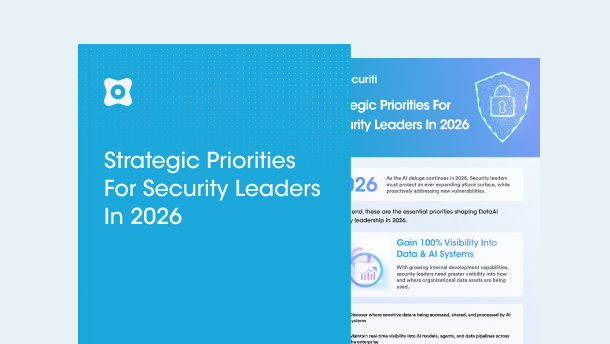
Strategic Priorities For Security Leaders In 2026
Securiti's whitepaper provides a detailed overview of the three-phased approach to AI Act compliance, making it essential reading for businesses operating with AI. Category:...
View More
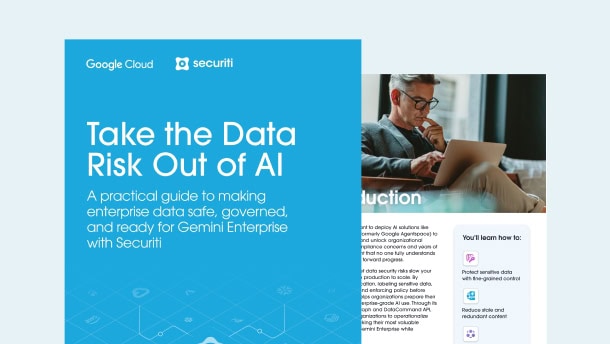
Take the Data Risk Out of AI
Learn how to prepare enterprise data for safe Gemini Enterprise adoption with upstream governance, sensitive data discovery, and pre-index policy controls.
View More
Navigating HITRUST: A Guide to Certification
Securiti's eBook is a practical guide to HITRUST certification, covering everything from choosing i1 vs r2 and scope systems to managing CAPs & planning...
What's
New