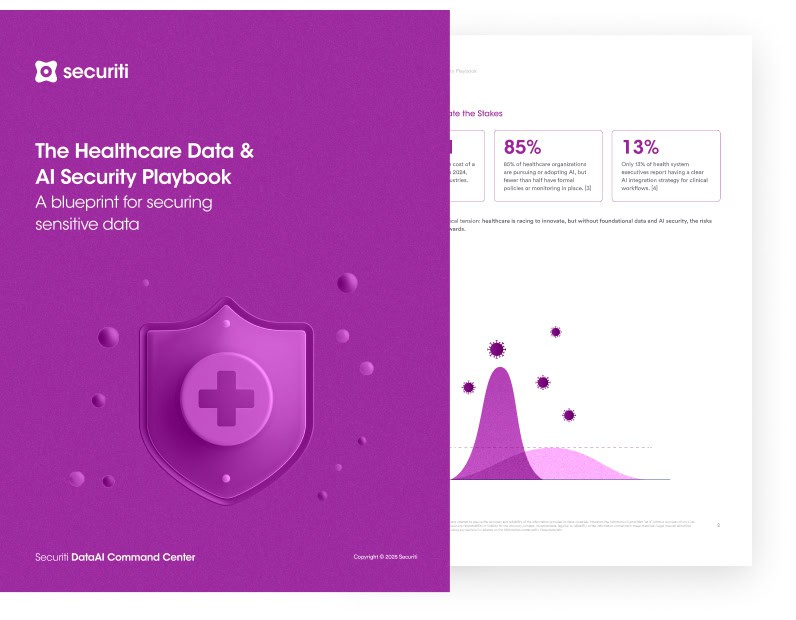
The healthcare sector is experiencing rapid AI adoption in areas such as diagnostics, drug discovery, and patient engagement. However, the stakes are far higher than in other industries. Missteps in safeguarding protected health information (PHI), clinical trial data, or AI-enabled diagnostic outputs can lead to massive regulatory fines, delays in therapies, reputational harm, and ultimately, loss of patient trust.
This playbook provides a practical blueprint for healthcare organizations to operationalize AI securely. You’ll learn how to prevent costly data exposure incidents (with the average healthcare breach costing $9.77M), implement AI security with masking, redaction, and governance controls, enforce least-privilege access to data, automate compliance with healthcare-specific regulations like HIPAA, FHIR, FDA/EMA, and GDPR, and reduce both cost and risk through ROT (redundant, obsolete, trivial) data minimization.
Data Security Posture Management (DSPM) unifies data visibility across hybrid and multicloud environments, ensures sensitive PHI and IP are governed properly, and integrates AI-specific controls such as masking, redaction, and access enforcement. By doing so, DSPM allows healthcare organizations to responsibly use AI in areas like clinical decision support, patient engagement, and drug research, without exposing sensitive data or violating compliance requirements.
Healthcare organizations must comply with a wide range of strict regulations, including HIPAA, HITECH, FHIR, FDA/EMA guidelines, and GDPR. AI adoption complicates compliance by introducing new risks around data provenance, transparency, and usage governance. This playbook explains how automation and AI-aware data governance controls can help organizations maintain continuous compliance and provide audit-ready evidence.
Large volumes of redundant, obsolete, and trivial (ROT) data inflate storage costs and broaden the attack surface for breaches. In healthcare, such data may include old patient records, trial datasets, or logs that are no longer needed but still pose compliance risks. By applying automated discovery, classification, and policy-driven remediation, organizations can reduce risk exposure, cut operational costs, and improve the effectiveness of AI systems that depend on clean, high-quality datasets.