Announcing Agent Commander - The First Integrated solution from Veeam + Securiti.ai enabling the scaling of safe AI agents

View

Austrian DPA Cookie FAQs

Download: Consent Report Q2 2024
Published June 18, 2022 / Updated January 25, 2024
Author

Maria Khan

Data Privacy Legal Manager at Securiti

FIP, CIPT, CIPM, CIPP/E

The use of cookies can be a tricky subject for websites given the rapid rise in data protection laws and compliance actions from various data protection regulatory authorities all around the world.

On 20 Dec 2023, the Austrian Data Protection Authority (DSB) released a set of Frequently Asked Questions about cookies and data protection outlining the requirements for the use of cookies on websites.

Let’s look into the key points highlighted by the Austrian DSB:

1. What is the legal framework for cookies?

  • Article 5(3) of the e-Privacy Directive which is implemented at the national level in Section 165(3) of the Austrian Telecommunication Act 2021 requires prior consent for the use of all technical unnecessary cookies.
  • Section 165(3) applies to not just cookies but also similar tracking technologies that access data from end users’ devices.

2. Are cookies personal data?

  • Cookies are qualified as personal data where they can identify individuals.
  • Cookies may contain universally unique identifiers (UUID) that are used to mark user devices. These identifiers contribute to the classification of cookies as personal data when they have the potential to identify specific individuals.

3. Which cookies are technically necessary?

  • The type of cookie that is essential for the proper functioning of a website or for providing an information society service expressly requested by the user.
  • Services for which technical cookies can be set includes:
    • Necessary session management (e.g. cookies saving shopping cart information or login status);
    • Entries in an online form if an entry on several subpages of a website is necessary to submit the form;
    • Information about the consent status, unless a clear online identifier is assigned for this.

4. Does your website need a cookie consent banner?

  • A cookie banner is a window that appears on a website when a visitor visits the site for the first time.
  • Its function is to obtain the user’s consent for the use of cookies.
  • Such consent from website visitors is only required if the website uses "technically unnecessary" cookies. If the website doesn't use any of these cookies, there is no need for consent, and consequently, no cookie banner is necessary.

5. How must a cookie banner be designed?

  • Ensure no technically unnecessary cookies are dropped on the website before obtaining the user’s consent.
  • Browsing the website without any interaction with the consent banner or accidentally selecting a “hidden consent button” does not constitute a valid consent;
  • Consent can not be assumed merely because a data subject generally sets their browser settings allowing cookies to be set or read.
  • Pre-selected checkboxes do not constitute valid consent.
  • To ensure consent is given voluntarily by the user, there must not be any disadvantages to the user for not giving consent to the use of cookies.
  • The banner must clearly and precisely indicate how consent can be revoked.
  • Withdrawing consent should be as easy as giving consent.
  • Refusing consent should be as easy as granting it on a cookie banner, without additional steps or complexity.
  • The purposes of cookies must be made clear to the user.
  • Data subjects should not be pressured to give consent via banner design choices.

6. Is it mandatory to inform visitors about the use of cookies on a website?

  • It depends on the types of cookies used. For "technically unnecessary" cookies, information must be provided about their setting and reading. This obligation applies regardless of whether the cookies involve personal data or not. Additionally, the user must be informed  if the use of cookies leads to the processing of personal data.

7. Can Accept and Reject buttons be of different colors?

  • Depends on a case-by-case assessment given both Accept and Reject buttons are equally visible.
    Example: If the background of the banner is white, the Accept button is red and the Reject button is also white, such a banner is not compliant.

8. How can a website fulfill its obligation to inform users about its use of cookies?

  • A multi-level approach is recommended.
  • The first information layer of the consent banner may include:
    • The identity of the data controller/website operator
    • Brief description of the processing purposes
    • The legal basis for data processing
    • An indication that consent can be revoked at any time without providing any reason and doing so does not affect the legality of prior processing
    •  How and where it can revoked
    • A link to a detailed information or the second information layer.

9. Is the use of cookie walls permitted?

  • The use of cookie walls also known as “pay or okay” is permitted if the following conditions are met:
    • Compliance with all data protection regulations particularly GDPR, for data processing based on consent
    • the requirements for the granularity of consent must be taken into account
    • The service provider must not be a public authority or other public bodies
    • There cannot be any exclusivity in relation to the content or services offered
    • The service provider cannot have a monopoly/quasi-monopoly position in the market
    • An appropriate and fair prices for the payment alternative
    • If a user gains access to the website using the payment alternative, no personal data may be processed for advertising purposes.

10. What is paywall and how is it different from a cookie wall?

  • A “paywall” requires a user to pay money to access the website when they visit the website, as the website operator can decide whether access to the content of their website is chargeable. While cookie wall presents users with the option to either pay for a website access or provide consent for the use of cookies.

Securiti’s Cookie Consent Management Solution can help you comply with Austrian requirements on the use of cookies by displaying the legally compliant consent banners with automatic cookie scanning & categorization, preference center, and audit trail features.

Request a DEMO

Disclaimer

Securiti has made every attempt to ensure the accuracy and reliability of the information provided in these materials. However, the information is provided “as is'' without warranty of any kind. Securiti does not accept any responsibility or liability for the accuracy, content, completeness, legality, or reliability of the information contained in these materials. Legal counsel should be consulted prior to making any decision in reliance on the information contained in these materials.

Analyze this article with AI

Prompts open in third-party AI tools.
Join Our Newsletter

Get all the latest information, law updates and more delivered to your inbox


Share
Videos
View More
Mitigating OWASP Top 10 for LLM Applications 2025
Generative AI (GenAI) has transformed how enterprises operate, scale, and grow. There’s an AI application for every purpose, from increasing employee productivity to streamlining...
View More
Top 6 DSPM Use Cases
With the advent of Generative AI (GenAI), data has become more dynamic. New data is generated faster than ever, transmitted to various systems, applications,...
View More
Colorado Privacy Act (CPA)
What is the Colorado Privacy Act? The CPA is a comprehensive privacy law signed on July 7, 2021. It established new standards for personal...
View More
Securiti for Copilot in SaaS
Accelerate Copilot Adoption Securely & Confidently Organizations are eager to adopt Microsoft 365 Copilot for increased productivity and efficiency. However, security concerns like data...
View More
Top 10 Considerations for Safely Using Unstructured Data with GenAI
A staggering 90% of an organization's data is unstructured. This data is rapidly being used to fuel GenAI applications like chatbots and AI search....
View More
Gencore AI: Building Safe, Enterprise-grade AI Systems in Minutes
As enterprises adopt generative AI, data and AI teams face numerous hurdles: securely connecting unstructured and structured data sources, maintaining proper controls and governance,...
View More
Navigating CPRA: Key Insights for Businesses
What is CPRA? The California Privacy Rights Act (CPRA) is California's state legislation aimed at protecting residents' digital privacy. It became effective on January...
View More
Navigating the Shift: Transitioning to PCI DSS v4.0
What is PCI DSS? PCI DSS (Payment Card Industry Data Security Standard) is a set of security standards to ensure safe processing, storage, and...
View More
Securing Data+AI : Playbook for Trust, Risk, and Security Management (TRiSM)
AI's growing security risks have 48% of global CISOs alarmed. Join this keynote to learn about a practical playbook for enabling AI Trust, Risk,...
AWS Startup Showcase Cybersecurity Governance With Generative AI View More
AWS Startup Showcase Cybersecurity Governance With Generative AI
Balancing Innovation and Governance with Generative AI Generative AI has the potential to disrupt all aspects of business, with powerful new capabilities. However, with...

Spotlight Talks

Spotlight 50:52
From Data to Deployment: Safeguarding Enterprise AI with Security and Governance
Watch Now View
Spotlight 11:29
Not Hype — Dye & Durham’s Analytics Head Shows What AI at Work Really Looks Like
Watch Now View
Spotlight 11:18
Rewiring Real Estate Finance — How Walker & Dunlop Is Giving Its $135B Portfolio a Data-First Refresh
Watch Now View
Spotlight 13:38
Accelerating Miracles — How Sanofi is Embedding AI to Significantly Reduce Drug Development Timelines
Sanofi Thumbnail
Watch Now View
Spotlight 10:35
There’s Been a Material Shift in the Data Center of Gravity
Watch Now View
Spotlight 14:21
AI Governance Is Much More than Technology Risk Mitigation
Watch Now View
Spotlight 12:!3
You Can’t Build Pipelines, Warehouses, or AI Platforms Without Business Knowledge
Watch Now View
Spotlight 47:42
Cybersecurity – Where Leaders are Buying, Building, and Partnering
Rehan Jalil
Watch Now View
Spotlight 27:29
Building Safe AI with Databricks and Gencore
Rehan Jalil
Watch Now View
Spotlight 46:02
Building Safe Enterprise AI: A Practical Roadmap
Watch Now View
Latest
View More
Introducing Agent Commander
The promise of AI Agents is staggering— intelligent systems that make decisions, use tools, automate complex workflows act as force multipliers for every knowledge...
Risk Silos: The Biggest AI Problem Boards Aren’t Talking About View More
Risk Silos: The Biggest AI Problem Boards Aren’t Talking About
Boards are tuned in to the AI conversation, but there’s a blind spot many organizations still haven’t named: risk silos. Everyone agrees AI governance...
Largest Fine In CCPA History_ What The Latest CCPA Enforcement Action Teaches Businesses View More
Largest Fine In CCPA History: What The Latest CCPA Enforcement Action Teaches Businesses
Businesses can take some vital lessons from the recent biggest enforcement action in CCPA history. Securiti’s blog covers all the important details to know.
View More
AI & HIPAA: What It Means and How to Automate Compliance
Explore how the Health Insurance Portability and Accountability Act (HIPAA) applies to Artificial Intelligence (AI) in securing Protected Health Information (PHI). Learn how to...
Building A Secure AI Foundation For Financial Services View More
Building A Secure AI Foundation For Financial Services
Access the whitepaper and discover how financial institutions eliminate Shadow AI, enforce real-time AI policies, and secure sensitive data with a unified DataAI control...
Indiana, Kentucky & Rhode Island Privacy Laws View More
Indiana, Kentucky & Rhode Island Privacy Laws: What Changed & What Businesses Should Do Now
A breakdown of new data privacy laws in Indiana, Kentucky, and Rhode Island—key obligations, consumer rights, enforcement timelines, and what businesses should do now.
Agentic AI Security: OWASP Top 10 with Enterprise Controls View More
Agentic AI Security: OWASP Top 10 with Enterprise Controls
Map the OWASP Top 10 risks for agentic AI to enterprise-grade controls, identity, data security, guardrails, monitoring, and governance to stop autonomous AI abuse.
View More
Strategic Priorities For Security Leaders In 2026
Securiti's whitepaper provides a detailed overview of the three-phased approach to AI Act compliance, making it essential reading for businesses operating with AI. Category:...
View More
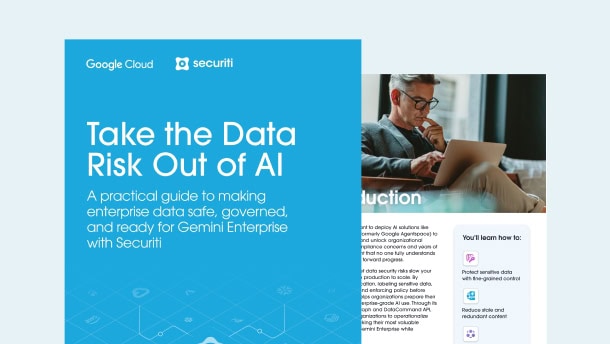
Take the Data Risk Out of AI
Learn how to prepare enterprise data for safe Gemini Enterprise adoption with upstream governance, sensitive data discovery, and pre-index policy controls.
View More
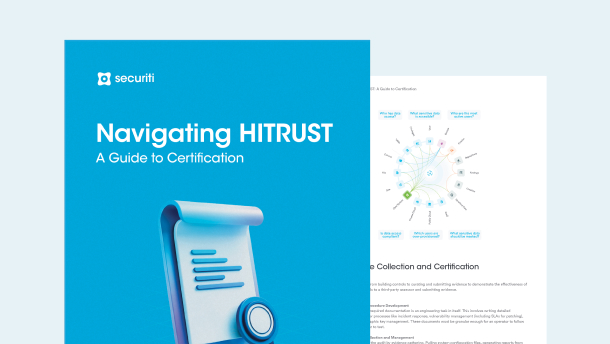
Navigating HITRUST: A Guide to Certification
Securiti's eBook is a practical guide to HITRUST certification, covering everything from choosing i1 vs r2 and scope systems to managing CAPs & planning...
What's
New