Announcing Agent Commander - The First Integrated solution from Veeam + Securiti.ai enabling the scaling of safe AI agents

View

AppSec (Application Security) refers to the process of creating secure coding policies, implementing robust security controls, and addressing vulnerabilities at the application level to safeguard app data or code.

Why is Application Security (AppSec) Critical?

In the current era, application security (AppSec) has become increasingly important for businesses and users globally. Be it a mobile application or a web or desktop-based application, these tools play a critical role in an individual’s day-to-day digital life. It helps them perform general or critical tasks and interact with the marvelous world of the Internet seamlessly. However, threat actors have made applications a prime target for digital attacks due to users' increasing reliance. That said, here are some of the following reasons why AppSec is essential:

  • The most important reason why organizations must strive for a robust AppSec framework is to thwart cyberattacks. Applications are targeted with various malware and other types of cyberattacks throughout the year. Establishing safeguards against such attacks is important to prevent data breaches or unauthorized access.
  • Besides data breaches and unauthorized access, cyberattacks can also cause business disruption. For instance, malware in a healthcare ERP can cause disruption across all healthcare organizations, resulting in serious concerns for critical patients.
  • Data privacy and protection laws are becoming increasingly important these days. Almost every region in the world has some kind of data laws enacted. In fact, many industries have relevant standards and frameworks built to ensure businesses’ responsibility for consumer data protection. One of the core provisions of such regulations also involves ensuring appropriate security measures to prevent unauthorized data access, damage, or destruction.
  • Building customer trust is another reason organizations should strive for a robust AppSec framework. Assuring users of a secure application experience builds trust and improves business reputation.

Common Threats and Vulnerabilities in Application Security

There are huge numbers of threats and vulnerabilities associated with application security. If not identified, treated, or prevented, those threats or vulnerabilities can compromise the confidentiality, accessibility, availability, and integrity of the application and its data.

  • Injection attacks are amongst the most common types of AppSec threats. Threat actors find vulnerabilities in the app and leverage it to inject any malicious code or command, which can compromise the integrity of the data or users’ privacy. The most common injection attacks mostly include SQL injection, cross-site scripting (XSS), command injection, etc.
  • Some authorization and authentication vulnerabilities can lead to application security risks, such as improper authentication or authorization processes. For example, attempting to access an admin-only page without proper credentials and gaining unauthorized access.
  • Application Programming Interfaces (APIs) offer a great way to interconnect different services and applications. However, unsecure APIs can result in security risks. Threat actors can leverage vulnerabilities in unsecure APIs to gain unauthorized access to or manipulate sensitive data.

Best Practices for Enhancing Application Security

Improving the security of applications is critical to protecting sensitive data against increasing numbers of cyber threats. Here are some of the best practices to improve application security.

  • Security should be integrated into the application right from the start, i.e., its design phase. It is more important to be proactive in thwarting cyber threats than reactive. Therefore, always consider threat modeling and other security requirements from the design phase. Security teams may also consider providing security awareness training to employees, hiring penetration testers, and creating strict security policies.
  • Code reviews should also be an integral part of the app development process. Any vulnerabilities or security gaps in the code can lead threat actors to the app or its valuable data.
  • Penetration testing should be performed sporadically to identify and resolve the app's vulnerabilities. Create a well-defined penetration testing policy informing the team of the activity's goals, methods, and expectations.
  • Integrate a robust authentication mechanism, such as a multi-factor authentication (MFA), during app development. These mechanisms improve applications’ security by verifying that only authorized users can access the application.

Tools and Technologies for Application Security Testing

Different types of app security testing tools are typically used. The Static Application Security Testing (SAST) tools help scan source codes, identify vulnerabilities, remediate the risks, and improve code quality and security. Similarly, Dynamic Application Security Testing (DAST) tools are used to scan web-based applications to identify security vulnerabilities, such as XSS or SQL injection, and help fix them. Interactive Application Security Testing (IAST) tools are often used to check for vulnerabilities and mitigate them in real-time.

Join Our Newsletter

Get all the latest information, law updates and more delivered to your inbox


Share
Videos
View More
Rehan Jalil, Veeam on Agent Commander : theCUBE + NYSE Wired: Cyber Security Leaders
Following Veeam’s acquisition of Securiti, the launch of Agent Commander marks an important step toward helping enterprises adopt AI agents with greater confidence. In...
View More
Mitigating OWASP Top 10 for LLM Applications 2025
Generative AI (GenAI) has transformed how enterprises operate, scale, and grow. There’s an AI application for every purpose, from increasing employee productivity to streamlining...
View More
Top 6 DSPM Use Cases
With the advent of Generative AI (GenAI), data has become more dynamic. New data is generated faster than ever, transmitted to various systems, applications,...
View More
Colorado Privacy Act (CPA)
What is the Colorado Privacy Act? The CPA is a comprehensive privacy law signed on July 7, 2021. It established new standards for personal...
View More
Securiti for Copilot in SaaS
Accelerate Copilot Adoption Securely & Confidently Organizations are eager to adopt Microsoft 365 Copilot for increased productivity and efficiency. However, security concerns like data...
View More
Top 10 Considerations for Safely Using Unstructured Data with GenAI
A staggering 90% of an organization's data is unstructured. This data is rapidly being used to fuel GenAI applications like chatbots and AI search....
View More
Gencore AI: Building Safe, Enterprise-grade AI Systems in Minutes
As enterprises adopt generative AI, data and AI teams face numerous hurdles: securely connecting unstructured and structured data sources, maintaining proper controls and governance,...
View More
Navigating CPRA: Key Insights for Businesses
What is CPRA? The California Privacy Rights Act (CPRA) is California's state legislation aimed at protecting residents' digital privacy. It became effective on January...
View More
Navigating the Shift: Transitioning to PCI DSS v4.0
What is PCI DSS? PCI DSS (Payment Card Industry Data Security Standard) is a set of security standards to ensure safe processing, storage, and...
View More
Securing Data+AI : Playbook for Trust, Risk, and Security Management (TRiSM)
AI's growing security risks have 48% of global CISOs alarmed. Join this keynote to learn about a practical playbook for enabling AI Trust, Risk,...

Spotlight Talks

Spotlight 50:52
From Data to Deployment: Safeguarding Enterprise AI with Security and Governance
Watch Now View
Spotlight 11:29
Not Hype — Dye & Durham’s Analytics Head Shows What AI at Work Really Looks Like
Watch Now View
Spotlight 11:18
Rewiring Real Estate Finance — How Walker & Dunlop Is Giving Its $135B Portfolio a Data-First Refresh
Watch Now View
Spotlight 13:38
Accelerating Miracles — How Sanofi is Embedding AI to Significantly Reduce Drug Development Timelines
Sanofi Thumbnail
Watch Now View
Spotlight 10:35
There’s Been a Material Shift in the Data Center of Gravity
Watch Now View
Spotlight 14:21
AI Governance Is Much More than Technology Risk Mitigation
Watch Now View
Spotlight 12:!3
You Can’t Build Pipelines, Warehouses, or AI Platforms Without Business Knowledge
Watch Now View
Spotlight 47:42
Cybersecurity – Where Leaders are Buying, Building, and Partnering
Rehan Jalil
Watch Now View
Spotlight 27:29
Building Safe AI with Databricks and Gencore
Rehan Jalil
Watch Now View
Spotlight 46:02
Building Safe Enterprise AI: A Practical Roadmap
Watch Now View
Latest
View More
Introducing Agent Commander
The promise of AI Agents is staggering— intelligent systems that make decisions, use tools, automate complex workflows act as force multipliers for every knowledge...
Risk Silos: The Biggest AI Problem Boards Aren’t Talking About View More
Risk Silos: The Biggest AI Problem Boards Aren’t Talking About
Boards are tuned in to the AI conversation, but there’s a blind spot many organizations still haven’t named: risk silos. Everyone agrees AI governance...
Largest Fine In CCPA History_ What The Latest CCPA Enforcement Action Teaches Businesses View More
Largest Fine In CCPA History: What The Latest CCPA Enforcement Action Teaches Businesses
Businesses can take some vital lessons from the recent biggest enforcement action in CCPA history. Securiti’s blog covers all the important details to know.
View More
AI & HIPAA: What It Means and How to Automate Compliance
Explore how the Health Insurance Portability and Accountability Act (HIPAA) applies to Artificial Intelligence (AI) in securing Protected Health Information (PHI). Learn how to...
View More
From Data Visibility to AI Velocity
Access the whitepaper and discover how unified DataAI security turns data governance into a business enabler, boosting AI innovation with visibility, compliance, and risk...
View More
EU Data Act Implementation Guide: Handling Data Access, Data Sharing, & Cloud Switching Requests
Securiti's whitepaper provides a detailed implementation guide to achieve Data Act compliance, making it essential reading for businesses operating with data in the EU.
Compliance with CCPA Amendments with Securiti View More
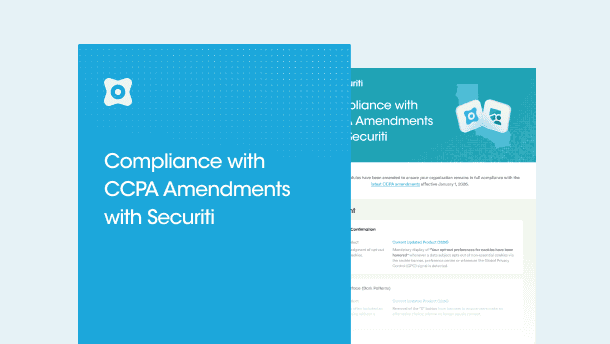
Compliance with CCPA Amendments with Securiti
Stay compliant with 2026 CCPA amendments using Securiti, covering updated consent requirements, expanded sensitive data definitions, enhanced consumer rights, and readiness assessments.
View More
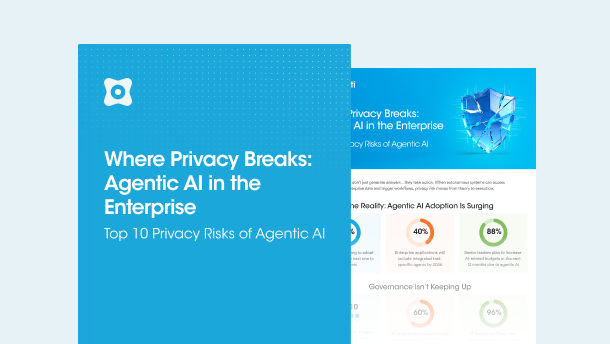
Where Privacy Breaks: Agentic AI in the Enterprise
Agentic AI is transforming enterprises, but at what cost to privacy? Discover the top 10 risks, key controls, and how Securiti enables safe, scalable...
View More
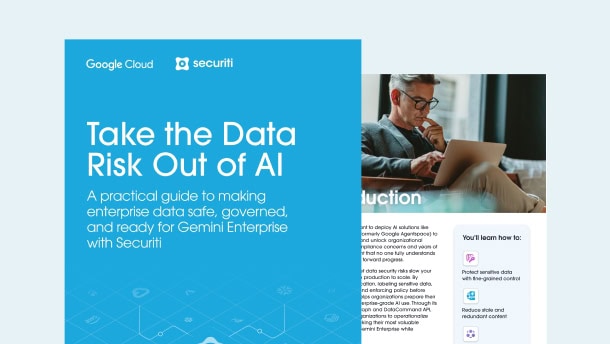
Take the Data Risk Out of AI
Learn how to prepare enterprise data for safe Gemini Enterprise adoption with upstream governance, sensitive data discovery, and pre-index policy controls.
View More
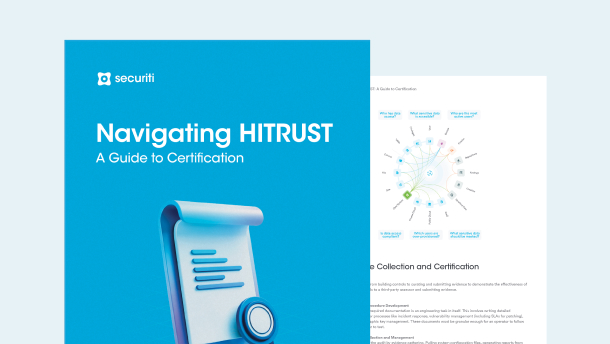
Navigating HITRUST: A Guide to Certification
Securiti's eBook is a practical guide to HITRUST certification, covering everything from choosing i1 vs r2 and scope systems to managing CAPs & planning...
What's
New