Announcing Agent Commander - The First Integrated solution from Veeam + Securiti.ai enabling the scaling of safe AI agents

View

Authentication refers to the process of validating or verifying the identity of a user, device, or entity who attempts to access a system or network. Authentication is typically done through credentials, biometrics, or other factors.

Why Does Authentication Matter?

Authentication is one of the core components of cybersecurity or information technology. The mechanism acts as the first line of defense against preventing threat actors from unauthorized access to sensitive resources or data. There are various reasons why authentication should matter to cybersecurity specialists. Let’s take a look at some of the most common reasons.

  • Authentication is a key element of an access control system. With authentication, security teams ensure that only authorized personnel can access specific systems or resources of the organization, including sensitive data. As mentioned earlier, authentication prevents unauthorized access and thus protects the confidentiality and integrity of the data.
  • Extending the same reason as discussed above, authentication protects sensitive data. It prevents any unauthorized personnel from accessing the data, manipulating or destroying it. Without robust authentication mechanisms, preventing the integrity or confidentiality of data from being exposed can be difficult.
  • Authentication is important in ensuring accountability and building trust across the organization. Authentication helps security teams verify the identity of every user attempting to gain access to any sensitive resource. With robust authentication mechanisms in place, users must prove their identity before accessing sensitive data.
  • Another important reason for implementing robust authentication mechanisms is to meet regulatory compliance requirements. Many data privacy laws and industry standards require strong authentication methods to protect data against unauthorized access, data loss, or destruction. Failure to comply results in legal, financial, and reputation consequences.

Types of Authentication Methods

Every authentication mechanism offers a distinct level of protection. Let’s take a look at some authentication methods followed most commonly by security professionals.

  • Password is the most common type of authentication method. Here, the user enters a set of unique characters, including alphabets, numbers, or symbols, which match their account credentials. While the mechanism is very simple and easy to implement, it is vulnerable to many password-based cyberattacks.
  • Biometric authentication is yet another method that can be used for authenticating users. It uses unique biological characteristics, such as the iris scan of an individual, fingerprints, or facial recognition, to provide access. Since every individual has distinct biometric characteristics, it is difficult and nearly impossible to forge biometric access.
  • Tokenization is another great practice for authenticating authorized individuals. In this approach, an individual carries temporary tokens, such as a one-time password, or a physical token, like a smart card, to gain access to a system or resource.
  • Two-factor authentication, or 2FA, is an effective authentication mechanism that leverages a user’s knowledge or possession for authorization, such as a password or a mobile device. 2FA protects users’ systems, resources, accounts, or data.
  • Multi-factor authentication is the enhanced version of 2FA, adding an extra layer on top of 2FA.

Multi-Factor Authentication (MFA) and Its Role in Security

Due to the growing cybersecurity concerns, security teams increasingly opt for multi-factor authentication mechanisms for data protection. The primary responsibility of this mechanism is to enhance security by applying multiple authentication factors, such as passwords, devices, PINs, SMS, etc. The mechanism further provides many other benefits, such as:

  • The mechanism significantly reduces the risk of unauthorized access to systems, resources, or sensitive data. After all, to gain access to sensitive resources, the attacker has to compromise not just one but multiple authentication methods, which is fairly difficult.
  • MFA also reduces the dependency on passwords. Passwords are the most vulnerable types of authentication mechanisms since there are many ways to crack them. However, using passwords in combination with other authentication factors, users can enhance their access control. After all, even if a password is compromised, the data would remain secure due to other mechanisms.
  • Multi-factor authentication is also great for improving the user experience. Using different combinations of authentication that are fairly easy to implement and use is better than remembering and using complex passwords. Instead, users can use multiple factors like PINs, device login, or SMSs to access accounts.

Best Practices for Secure Authentication

Organizations can consider the following best practices to enhance their authentication mechanisms.

  • Since passwords are commonly combined with other authentication factors, it is important to create complex passwords. Security teams must create strict password creation policies encouraging users to use highly complex passwords involving special characters, symbols, capitalized letters, etc. Security teams should further encourage employees to update their passwords sporadically, which should be part of the policy.
  • Organizations should strive for multi-factor authentication instead of two to enhance user authentication security.
  • Security teams should also monitor regulatory authentication logs to detect suspicious activities and prevent security risks.
Join Our Newsletter

Get all the latest information, law updates and more delivered to your inbox


Share
Videos
View More
Rehan Jalil, Veeam on Agent Commander : theCUBE + NYSE Wired: Cyber Security Leaders
Following Veeam’s acquisition of Securiti, the launch of Agent Commander marks an important step toward helping enterprises adopt AI agents with greater confidence. In...
View More
Mitigating OWASP Top 10 for LLM Applications 2025
Generative AI (GenAI) has transformed how enterprises operate, scale, and grow. There’s an AI application for every purpose, from increasing employee productivity to streamlining...
View More
Top 6 DSPM Use Cases
With the advent of Generative AI (GenAI), data has become more dynamic. New data is generated faster than ever, transmitted to various systems, applications,...
View More
Colorado Privacy Act (CPA)
What is the Colorado Privacy Act? The CPA is a comprehensive privacy law signed on July 7, 2021. It established new standards for personal...
View More
Securiti for Copilot in SaaS
Accelerate Copilot Adoption Securely & Confidently Organizations are eager to adopt Microsoft 365 Copilot for increased productivity and efficiency. However, security concerns like data...
View More
Top 10 Considerations for Safely Using Unstructured Data with GenAI
A staggering 90% of an organization's data is unstructured. This data is rapidly being used to fuel GenAI applications like chatbots and AI search....
View More
Gencore AI: Building Safe, Enterprise-grade AI Systems in Minutes
As enterprises adopt generative AI, data and AI teams face numerous hurdles: securely connecting unstructured and structured data sources, maintaining proper controls and governance,...
View More
Navigating CPRA: Key Insights for Businesses
What is CPRA? The California Privacy Rights Act (CPRA) is California's state legislation aimed at protecting residents' digital privacy. It became effective on January...
View More
Navigating the Shift: Transitioning to PCI DSS v4.0
What is PCI DSS? PCI DSS (Payment Card Industry Data Security Standard) is a set of security standards to ensure safe processing, storage, and...
View More
Securing Data+AI : Playbook for Trust, Risk, and Security Management (TRiSM)
AI's growing security risks have 48% of global CISOs alarmed. Join this keynote to learn about a practical playbook for enabling AI Trust, Risk,...

Spotlight Talks

Spotlight 50:52
From Data to Deployment: Safeguarding Enterprise AI with Security and Governance
Watch Now View
Spotlight 11:29
Not Hype — Dye & Durham’s Analytics Head Shows What AI at Work Really Looks Like
Watch Now View
Spotlight 11:18
Rewiring Real Estate Finance — How Walker & Dunlop Is Giving Its $135B Portfolio a Data-First Refresh
Watch Now View
Spotlight 13:38
Accelerating Miracles — How Sanofi is Embedding AI to Significantly Reduce Drug Development Timelines
Sanofi Thumbnail
Watch Now View
Spotlight 10:35
There’s Been a Material Shift in the Data Center of Gravity
Watch Now View
Spotlight 14:21
AI Governance Is Much More than Technology Risk Mitigation
Watch Now View
Spotlight 12:!3
You Can’t Build Pipelines, Warehouses, or AI Platforms Without Business Knowledge
Watch Now View
Spotlight 47:42
Cybersecurity – Where Leaders are Buying, Building, and Partnering
Rehan Jalil
Watch Now View
Spotlight 27:29
Building Safe AI with Databricks and Gencore
Rehan Jalil
Watch Now View
Spotlight 46:02
Building Safe Enterprise AI: A Practical Roadmap
Watch Now View
Latest
View More
Introducing Agent Commander
The promise of AI Agents is staggering— intelligent systems that make decisions, use tools, automate complex workflows act as force multipliers for every knowledge...
Risk Silos: The Biggest AI Problem Boards Aren’t Talking About View More
Risk Silos: The Biggest AI Problem Boards Aren’t Talking About
Boards are tuned in to the AI conversation, but there’s a blind spot many organizations still haven’t named: risk silos. Everyone agrees AI governance...
Largest Fine In CCPA History_ What The Latest CCPA Enforcement Action Teaches Businesses View More
Largest Fine In CCPA History: What The Latest CCPA Enforcement Action Teaches Businesses
Businesses can take some vital lessons from the recent biggest enforcement action in CCPA history. Securiti’s blog covers all the important details to know.
View More
AI & HIPAA: What It Means and How to Automate Compliance
Explore how the Health Insurance Portability and Accountability Act (HIPAA) applies to Artificial Intelligence (AI) in securing Protected Health Information (PHI). Learn how to...
View More
The Convergence Blueprint for Enterprise-Scale AI Governance
A blueprint for enterprise-scale AI governance - unifying data, security, privacy, and risk controls to manage AI systems, ensure compliance, and enable safe innovation.
Navigating Australia’s Evolving Cyber, Data & AI Regulatory Landscape View More
Navigating Australia’s Evolving Cyber, Data & AI Regulatory Landscape
Access the whitepaper and explore Australia’s evolving cyber, data, and AI risk landscape, including SOCI Act obligations, sector cyber standards, Privacy Act reforms, and...
DataAI Security for Retail View More
DataAI Security for Retail
Download the brief and explore how retailers can securely scale Data & AI with Securiti DataAI Command Center and protect sensitive data, manage risk,...
Emerging AI Security Trends For 2026 View More
Emerging AI Security Trends For 2026
Securiti’s latest infographic provides security leaders with a walkthrough of all the emerging AI security trends for 2026 to help them assess and plan...
View More
Take the Data Risk Out of AI
Learn how to prepare enterprise data for safe Gemini Enterprise adoption with upstream governance, sensitive data discovery, and pre-index policy controls.
View More
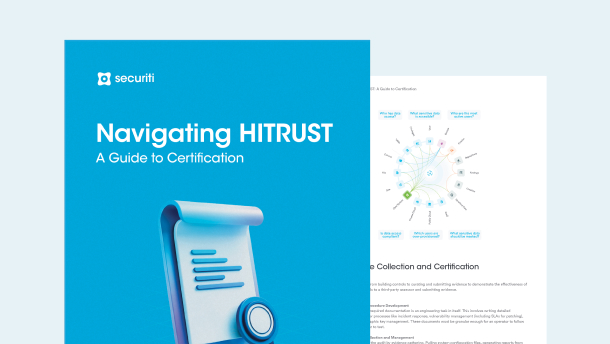
Navigating HITRUST: A Guide to Certification
Securiti's eBook is a practical guide to HITRUST certification, covering everything from choosing i1 vs r2 and scope systems to managing CAPs & planning...
What's
New