Mississippi's Data Protection Law: A Comprehensive Overview

Published August 16, 2024 / Updated March 10, 2025

Contributors

Anas Baig

Product Marketing Manager at Securiti

Usman Tariq

Senior Global Compliance Analyst at Securiti

CIPP/US

Data has always been important for businesses globally. In fact, it has become increasingly more significant due to the advancements in Artificial Intelligence, especially Generative AI (GenAI). Businesses are now leveraging vast volumes of data to train their GenAI pipelines or fine-tune their AI-powered applications.

However, the datasets used to train GenAI or leveraged for strategic business decision-making may contain sensitive personal data. If proper security, governance, and compliance controls aren’t placed around these datasets, it would lead to critical security breaches. Here, data protection laws and AI regulations come into the picture.

States across the US are working tirelessly to propose or implement regulations to enable safe and responsible use of data and AI. However, there are still many states in the country that have yet to propose and establish any comprehensive state-wide data protection law. Amongst such states that have no state privacy law is Mississippi.

In this guide, we will discuss Mississippi's data privacy landscape and what businesses must do to stay compliant and ensure responsible use of personal information (PI).

Understanding Mississippi's Data Privacy Regulations Landscape

As mentioned earlier, Mississippi doesn’t have any state-specific comprehensive privacy law. However, businesses shouldn’t overlook the best data privacy and security practices because there are other regulations that are equally significant. Take, for instance, the security breach notification guidelines that are specific to the state of Mississippi. Let’s take a quick look at some of the important provisions or guidelines of the regulation.

Mississippi Security Breach Notification Law

The law applies to every business operating in the state of Mississippi that, in its routine course of business, collects, maintains, or processes the personal information of the state's residents. The law defines a security breach as any unauthorized access to business files, applications, or documents that contain the personal information of a Mississippi resident while access to the PI wasn’t protected using encryption or similar security measures that could render access to the sensitive information unreadable or unusable.

The law requires that individuals or entities conducting business in Mississippi must notify the affected individuals about the security breach. However, if the controller determines, after a careful review or investigation of the breach, that the breach will not likely do any harm to the individuals, no notification would be required. In the case of a third party, the third party that maintains the PI of an individual must inform the controller regarding the breach if they have reasons to believe that an unauthorized individual has acquired the PI.

The entity must provide the notice without undue delay. The notification timing may be subject to the investigation conducted by the entity to evaluate and determine the scope and nature of the breach and to identify the impacted identities. Notification provided to the concerned parties can be in the form of written notice, telephonic communication, or electronic means.

The entity may consider a substitute notice if it believes that the notification cost would exceed $5,000 or the entity has to notify more than 5,000 individuals or the entity doesn’t have sufficient contact information. In such an event, the entity may send email notifications to the concerned parties, display a notice on its website, or send the notification via state-wide media.

Health Insurance Portability and Accountability Act (HIPAA)

The HIPAA regulation is designed to set strict measures and standards for protecting protected health information (PHI). The regulation applies to entities that manage patients’ health information, such as medical services and healthcare providers. The regulation restricts the use and disclosure of sensitive health information and grants patients privacy rights. For instance, patients can request the right to obtain a copy of their data, the right to examine, and the right to make necessary corrections.

The regulation requires HIPAA-covered entities to implement strict administrative, technical, and organizational security measures. Covered entities must ensure the integrity and confidentiality of patient health data by safeguarding it against reasonably anticipated cyber threats. However, in the event of a security breach, covered entities must notify impacted individuals and concerned authorities without undue delay.

Final Thoughts

Businesses must streamline their data management and privacy practices to stay compliant with federal laws and industry standards. To begin with, businesses must ensure a simple and effortless way for data subjects to file their requests. Updated privacy notices should be present on websites at all times. Businesses should further enable robust security frameworks to prevent any unauthorized access to covered data.

Join Our Newsletter

Get all the latest information, law updates and more delivered to your inbox

Videos
View More
Rehan Jalil, Veeam on Agent Commander : theCUBE + NYSE Wired: Cyber Security Leaders
Following Veeam’s acquisition of Securiti, the launch of Agent Commander marks an important step toward helping enterprises adopt AI agents with greater confidence. In...
View More
Mitigating OWASP Top 10 for LLM Applications 2025
Generative AI (GenAI) has transformed how enterprises operate, scale, and grow. There’s an AI application for every purpose, from increasing employee productivity to streamlining...
View More
Top 6 DSPM Use Cases
With the advent of Generative AI (GenAI), data has become more dynamic. New data is generated faster than ever, transmitted to various systems, applications,...
View More
Colorado Privacy Act (CPA)
What is the Colorado Privacy Act? The CPA is a comprehensive privacy law signed on July 7, 2021. It established new standards for personal...
View More
Securiti for Copilot in SaaS
Accelerate Copilot Adoption Securely & Confidently Organizations are eager to adopt Microsoft 365 Copilot for increased productivity and efficiency. However, security concerns like data...
View More
Top 10 Considerations for Safely Using Unstructured Data with GenAI
A staggering 90% of an organization's data is unstructured. This data is rapidly being used to fuel GenAI applications like chatbots and AI search....
View More
Gencore AI: Building Safe, Enterprise-grade AI Systems in Minutes
As enterprises adopt generative AI, data and AI teams face numerous hurdles: securely connecting unstructured and structured data sources, maintaining proper controls and governance,...
View More
Navigating CPRA: Key Insights for Businesses
What is CPRA? The California Privacy Rights Act (CPRA) is California's state legislation aimed at protecting residents' digital privacy. It became effective on January...
View More
Navigating the Shift: Transitioning to PCI DSS v4.0
What is PCI DSS? PCI DSS (Payment Card Industry Data Security Standard) is a set of security standards to ensure safe processing, storage, and...
View More
Securing Data+AI : Playbook for Trust, Risk, and Security Management (TRiSM)
AI's growing security risks have 48% of global CISOs alarmed. Join this keynote to learn about a practical playbook for enabling AI Trust, Risk,...

Spotlight Talks

Spotlight 00:00
AI Agents Unleashed? The Future of Identity & Data Access Security
Watch Now View
Spotlight 00:00
IDC Research: Why Data, AI, Identity and Access Security Must Come Together
Watch Now View
Spotlight 59:11
Data Controls for AI: Findings from the 2026 GigaOm DSPM Research
Watch Now View
Spotlight 1:02:06
Consent by proxy: When AI agents start deciding for us
Watch Now View
Spotlight 1:00:41
Future-Proofing for the Privacy Professional
Watch Now View
Spotlight 50:52
From Data to Deployment: Safeguarding Enterprise AI with Security and Governance
Watch Now View
Spotlight 11:29
Not Hype — Dye & Durham’s Analytics Head Shows What AI at Work Really Looks Like
Watch Now View
Spotlight 11:18
Rewiring Real Estate Finance — How Walker & Dunlop Is Giving Its $135B Portfolio a Data-First Refresh
Watch Now View
Spotlight
Choosing the Right DSPM: An Industry Analyst’s Perspective
Watch Now View
Spotlight 13:38
Accelerating Miracles — How Sanofi is Embedding AI to Significantly Reduce Drug Development Timelines
Sanofi Thumbnail
Watch Now View
Latest
KSA PDPL in 2026 View More
KSA PDPL in 2026: What Organizations Need to Know Now
KSA's Personal Data Protection Law (PDPL) has been fully enforceable since 14th September 2024. Over the past two years, organizations have been navigating overlapping...
EU Digital Sovereignty View More
EU Digital Sovereignty is Moving from Policy to Procurement: What Organizations Need to Know
Digital sovereignty in Europe is moving from policy ambition toward something much more concrete: a framework that can determine how cloud services are assessed,...
View More
What Is Unstructured Data Discovery? A Practical Guide
Unstructured data discovery finds sensitive data in files, chats, and cloud storage. Securiti explains how it works, common challenges, and best practices.
Data Anonymization View More
What Is Data Anonymization
What is data anonymization? Securiti’s latest blog explains how it works, key techniques, and how it differs from pseudonymization. Read to learn more.
Saudi PDPL Compliance Toolkit View More
Saudi PDPL Compliance Toolkit
Turn Saudi PDPL requirements into action with practical checklists, a maturity self-assessment, and a 90-day plan for privacy and compliance leaders.
From Compliance to Continuous Assurance View More
From Compliance to Continuous Assurance: The Next Era of Saudi Data Protection
PDPL compliance didn’t end with the deadline. Learn how to comply with SDAIA enforcement requirements, govern cross-border transfers, and prepare your data for AI.
Data Minimization, Data Minimization for AI, Safe AI, AI Readiness, ROT Data, AI Governance, Data Governance, Data and AI Security, AI Risk Management, Sensitive Data View More
Minimize Before You Scale
Discover why redundant, obsolete, and trivial (ROT) data raises AI-era risks and how to minimize them. Explore practical fixes and business outcomes.
The PDPL Operational Lifecycle View More
The PDPL Operational Lifecycle
Find it. Fix it. Prove it. Repeat. Explore the 10-stage PDPL operational lifecycle, key deadlines, and the evidence regulators expect.
View More
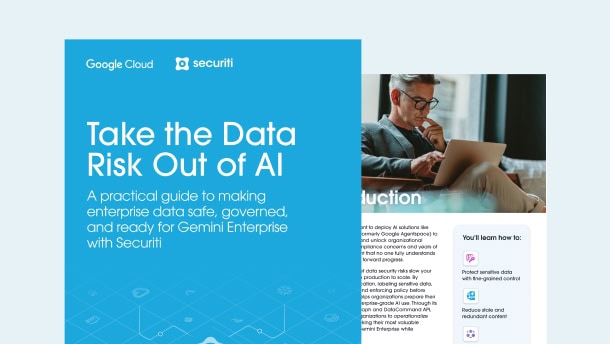
Take the Data Risk Out of AI
Learn how to prepare enterprise data for safe Gemini Enterprise adoption with upstream governance, sensitive data discovery, and pre-index policy controls.
View More
Navigating HITRUST: A Guide to Certification
Securiti's eBook is a practical guide to HITRUST certification, covering everything from choosing i1 vs r2 and scope systems to managing CAPs & planning...
What's
New