
Cloud Data Management Capabilities (CDMC) Assessment

Author

Anas Baig

Product Marketing Manager at Securiti

The Cloud Data Management Capabilities (CDMC) framework helps organizations assess their readiness to manage, govern, protect, and control data in cloud environments. This evaluation tool helps your organization assess its readiness across core cloud data management capabilities and identify where stronger governance, automation, and technical controls may be needed.

The assessment considers factors such as cloud data governance, ownership, sourcing, sovereignty, cataloging, classification, entitlements, privacy, lifecycle management, data quality, technical architecture, and lineage.

1. Have you defined cloud data management business cases and linked them to measurable value, risk reduction, and stakeholder accountability?

Effective cloud data management business cases should define expected outcomes, include measures of effectiveness, list responsible stakeholders, and include SMART metrics tied to value realization, such as cost reduction, risk mitigation, or new revenue.

2. Have you formally assigned data ownership roles and responsibilities for data across both on-premises and cloud environments?

It treats data ownership as a core governance capability, expects ownership to be defined by policy, extended to cloud-hosted and CSP-generated data, and tracks it before data is available for consumption.

3. Have you established authoritative data sources and controlled how data is sourced and consumed?

It expects organizations to define authoritative data sources, document data use requirements and provisioning points, educate stakeholders, and map requested data elements back to authoritative sources.

4. Do you track data sovereignty, location, jurisdiction, and cross-border movement requirements for cloud data?

It expects a policy for cloud data location management, metadata for sovereignty and jurisdiction, and consistent enforcement of cross-border movement controls with automated monitoring and evidence.

5. Do you maintain a searchable, governed, and interoperable data catalog across cloud and on-premises environments?

It makes cataloging foundational. It expects a formal cataloging strategy, automatic discovery and metadata enrichment, interoperability across catalogs, and evidence that the catalog scope aligns with business objectives.

6. Do you classify data consistently at creation or ingestion and use classification to drive downstream controls?

It expects formal information sensitivity classification schemes, business rules, automated classification, and use of classifications as the basis for access, usage, encryption, storage, sharing, and destruction.

7. Are data entitlements, rights, and access controls defined, automated, and tracked for sensitive data?

It expects rights and obligations to be captured as metadata, linked to the data catalog, and used to automate enforcement. It also expects sensitive-data access to default to the creator and owner until explicitly granted.

8. Have you established data ethics structures and defined acceptable data consumption purposes for sensitive-data sharing?

It expects a senior executive accountable for data ethics, a Code of Data Ethics, governance structures, reporting and remediation processes, and a documented data consumption purpose for sensitive-data sharing agreements.

9. Do you have security controls for sensitive data, including encryption, obfuscation, DLP, and evidence of control effectiveness?

It groups encryption, security control evidence, obfuscation, and data loss prevention into a single major capability area and expects appropriate controls to be enabled and evidenced for sensitive data.

10. Do you operate a cloud-ready privacy framework, including PETs, DPIA triggers, and privacy-by-design practices?

It expects a cloud-specific privacy framework with defined roles, processes for personal-data discovery and inventory, privacy-enhancing technologies, regulators and data-subject response mechanisms, and automatic triggering of DPIAs for personal data in relevant jurisdictions.

11. Do you manage retention, archiving, purging, and lifecycle stages through metadata-driven controls?

It expects approved lifecycle taxonomies, metadata-driven lifecycle management, asset mapping to retention schedules, and automated archiving or destruction.

12. Do you measure and manage data quality through formal rules, metrics, issue tracking, and reporting?

It expects standards for data quality rules, measurement processes, metrics reports, and issue-management workflows linked back to data catalog metadata.

13. . Do you maintain technical architecture principles for cloud optimization, resilience, backup, portability, and exit planning?

It expects documented architecture patterns, cost metrics, resilience requirements, backup and recovery plans, and approved portability or exit plans for cloud providers.

14. Do you automatically discover, record, and report data lineage across on-premises, hybrid, and multi-cloud environments?

It expects automated lineage discovery, lineage metadata in the data catalog, historic lineage reporting, and linkage between lineage changes and business or technology change events.

15. Can you produce evidence, policies, logs, catalogs, reports, and other artifacts showing adherence to CDMC sub-capabilities and controls?

It repeatedly ties each sub-capability to specific evidence such as policies, standards, catalogs, logs, reports, templates, governance charters, and implementation roadmaps.

Turn Your CDMC Assessment Into an Action Plan

Based on your responses, your organization may need to strengthen key areas of data management control readiness, including data ownership, cataloging, classification, lineage, quality, access governance, protection controls, retention, policy enforcement, and evidence management.

Securiti helps data, privacy, and governance teams operationalize CDMC readiness by automating data discovery, classification, control mapping, policy workflows, risk monitoring, access governance, and compliance evidence.

Get a personalized CDMC readiness walkthrough to identify control gaps and prioritize next steps.

BOOK MY CDMC READINESS WALKTHROUGH

Join Our Newsletter

Get all the latest information, law updates and more delivered to your inbox


Share

More Stories that May Interest You

See the platform live

Ready to see DataAI Command Platform in action?

See how your team can discover sensitive data, reduce risk, and secure AI usage from one command center.

Book a demo
Demo BG Book a demo
Videos
View More
Rehan Jalil, Veeam on Agent Commander : theCUBE + NYSE Wired: Cyber Security Leaders
Following Veeam’s acquisition of Securiti, the launch of Agent Commander marks an important step toward helping enterprises adopt AI agents with greater confidence. In...
View More
Mitigating OWASP Top 10 for LLM Applications 2025
Generative AI (GenAI) has transformed how enterprises operate, scale, and grow. There’s an AI application for every purpose, from increasing employee productivity to streamlining...
View More
Top 6 DSPM Use Cases
With the advent of Generative AI (GenAI), data has become more dynamic. New data is generated faster than ever, transmitted to various systems, applications,...
View More
Colorado Privacy Act (CPA)
What is the Colorado Privacy Act? The CPA is a comprehensive privacy law signed on July 7, 2021. It established new standards for personal...
View More
Securiti for Copilot in SaaS
Accelerate Copilot Adoption Securely & Confidently Organizations are eager to adopt Microsoft 365 Copilot for increased productivity and efficiency. However, security concerns like data...
View More
Top 10 Considerations for Safely Using Unstructured Data with GenAI
A staggering 90% of an organization's data is unstructured. This data is rapidly being used to fuel GenAI applications like chatbots and AI search....
View More
Gencore AI: Building Safe, Enterprise-grade AI Systems in Minutes
As enterprises adopt generative AI, data and AI teams face numerous hurdles: securely connecting unstructured and structured data sources, maintaining proper controls and governance,...
View More
Navigating CPRA: Key Insights for Businesses
What is CPRA? The California Privacy Rights Act (CPRA) is California's state legislation aimed at protecting residents' digital privacy. It became effective on January...
View More
Navigating the Shift: Transitioning to PCI DSS v4.0
What is PCI DSS? PCI DSS (Payment Card Industry Data Security Standard) is a set of security standards to ensure safe processing, storage, and...
View More
Securing Data+AI : Playbook for Trust, Risk, and Security Management (TRiSM)
AI's growing security risks have 48% of global CISOs alarmed. Join this keynote to learn about a practical playbook for enabling AI Trust, Risk,...

Spotlight Talks

Spotlight 00:00
AI Agents Unleashed? The Future of Identity & Data Access Security
Watch Now View
Spotlight 00:00
IDC Research: Why Data, AI, Identity and Access Security Must Come Together
Watch Now View
Spotlight 59:11
Data Controls for AI: Findings from the 2026 GigaOm DSPM Research
Watch Now View
Spotlight 1:02:06
Consent by proxy: When AI agents start deciding for us
Watch Now View
Spotlight 1:00:41
Future-Proofing for the Privacy Professional
Watch Now View
Spotlight 50:52
From Data to Deployment: Safeguarding Enterprise AI with Security and Governance
Watch Now View
Spotlight 11:29
Not Hype — Dye & Durham’s Analytics Head Shows What AI at Work Really Looks Like
Watch Now View
Spotlight 11:18
Rewiring Real Estate Finance — How Walker & Dunlop Is Giving Its $135B Portfolio a Data-First Refresh
Watch Now View
Spotlight
Choosing the Right DSPM: An Industry Analyst’s Perspective
Watch Now View
Spotlight 13:38
Accelerating Miracles — How Sanofi is Embedding AI to Significantly Reduce Drug Development Timelines
Sanofi Thumbnail
Watch Now View
Latest
KSA PDPL in 2026 View More
KSA PDPL in 2026: What Organizations Need to Know Now
KSA's Personal Data Protection Law (PDPL) has been fully enforceable since 14th September 2024. Over the past two years, organizations have been navigating overlapping...
EU Digital Sovereignty View More
EU Digital Sovereignty is Moving from Policy to Procurement: What Organizations Need to Know
Digital sovereignty in Europe is moving from policy ambition toward something much more concrete: a framework that can determine how cloud services are assessed,...
View More
What Is Unstructured Data Discovery? A Practical Guide
Unstructured data discovery finds sensitive data in files, chats, and cloud storage. Securiti explains how it works, common challenges, and best practices.
Data Anonymization View More
What Is Data Anonymization
What is data anonymization? Securiti’s latest blog explains how it works, key techniques, and how it differs from pseudonymization. Read to learn more.
Saudi PDPL Compliance Toolkit View More
Saudi PDPL Compliance Toolkit
Turn Saudi PDPL requirements into action with practical checklists, a maturity self-assessment, and a 90-day plan for privacy and compliance leaders.
From Compliance to Continuous Assurance View More
From Compliance to Continuous Assurance: The Next Era of Saudi Data Protection
PDPL compliance didn’t end with the deadline. Learn how to comply with SDAIA enforcement requirements, govern cross-border transfers, and prepare your data for AI.
Data Minimization, Data Minimization for AI, Safe AI, AI Readiness, ROT Data, AI Governance, Data Governance, Data and AI Security, AI Risk Management, Sensitive Data View More
Minimize Before You Scale
Discover why redundant, obsolete, and trivial (ROT) data raises AI-era risks and how to minimize them. Explore practical fixes and business outcomes.
The PDPL Operational Lifecycle View More
The PDPL Operational Lifecycle
Find it. Fix it. Prove it. Repeat. Explore the 10-stage PDPL operational lifecycle, key deadlines, and the evidence regulators expect.
View More
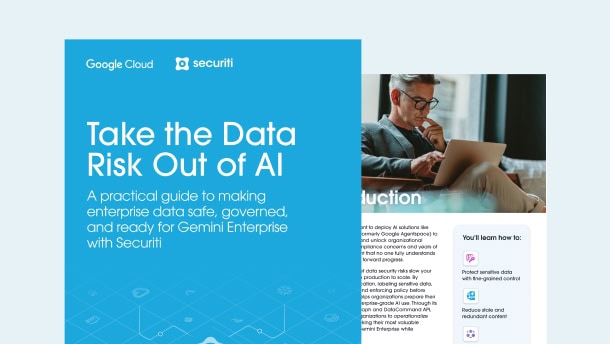
Take the Data Risk Out of AI
Learn how to prepare enterprise data for safe Gemini Enterprise adoption with upstream governance, sensitive data discovery, and pre-index policy controls.
View More
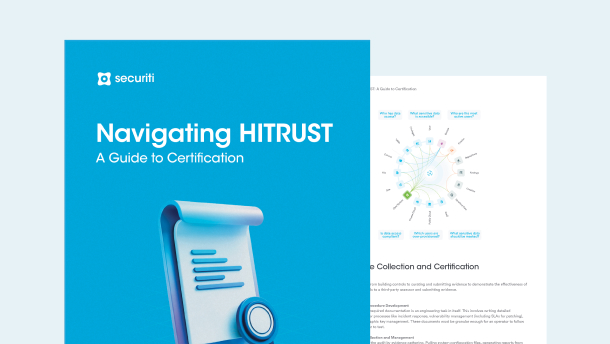
Navigating HITRUST: A Guide to Certification
Securiti's eBook is a practical guide to HITRUST certification, covering everything from choosing i1 vs r2 and scope systems to managing CAPs & planning...
What's
New