Accelerating Safe Enterprise AI with Gencore Sync & Databricks

Author

Rehan Jalil

formerly CEO of Securiti AI, and now President of Products & Tech at Veeam

Listen to the content

This post is also available in: Arabic

We are delighted to announce new capabilities in Gencore AI to support Databricks' Mosaic AI and Delta Tables! This support enables organizations to selectively and securely bring unstructured data and security context from hundreds of data systems into Databricks Delta Tables. As a result, businesses can easily build safe, enterprise-grade AI systems and AI agents using their proprietary data with Databricks.

Figure 1: Accelerating Safe Enterprise AI Development with Gencore AI & Databricks

The biggest barrier to deploying GenAI systems within organizations is safely and reliably using data from diverse data system instances, while ensuring proper controls and governance throughout the AI pipeline. Since the majority of an organization's data is unstructured data, it’s critical to properly govern and control these assets.
Gencore AI accelerates GenAI adoption in the enterprise by making it easy to build AI pipelines using data from hundreds of data systems. Organizations can now safely harness the power of their unstructured and structured data anywhere with Databricks.

Figure 2: Safely Syncing Unstructured Data to Databricks Delta Tables for Enterprise AI Use Cases

To enable rapid GenAI innovation with proprietary data at scale, three key considerations have to be accounted for.

1. Ease of Building and Operating Safe AI Systems

A typical enterprise has dozens or hundreds of GenAI use cases that need to be implemented and operated. To effectively deploy and manage these GenAI projects at scale, organizations need software tooling that seamlessly integrates unstructured and structured data from diverse systems with GenAI models.

Gencore AI streamlines data ingestion by connecting to both unstructured and structured data across different systems and applications, while allowing the use of any foundational or custom AI models in Databricks.

Data & AI teams can configure and operationalize these AI systems in minutes.

Figure 3(a). Configuring and Operationalizing Safe AI Systems in Minutes (UI-Based)

Figure 3(b). Configuring and Operationalizing Safe AI Systems in Minutes (API-Based)

2. Embedded Security and Governance in AI Systems

Security, governance and safe use of proprietary data is the top need and baseline requirement for CIOs and CISOs for GenAI projects. It's a key concern in moving from proof of concepts to production enterprise-grade systems.

Gencore AI aligns with OWASP Top 10 for LLMs to help embed data security and governance at every important stage of the AI System within Databricks, from data ingestion to AI consumption layers.

Gencore AI automatically sanitizes data at ingestion, brings entitlements from source systems and enforces entitlements at AI consumption, protects activity on embeddings in vector DBs, and inspects and controls prompts and responses.

Figure 4. Building Safe Enterprise AI Systems with Databricks & Gencore AI

3. Complete Provenance Tracking for AI Systems

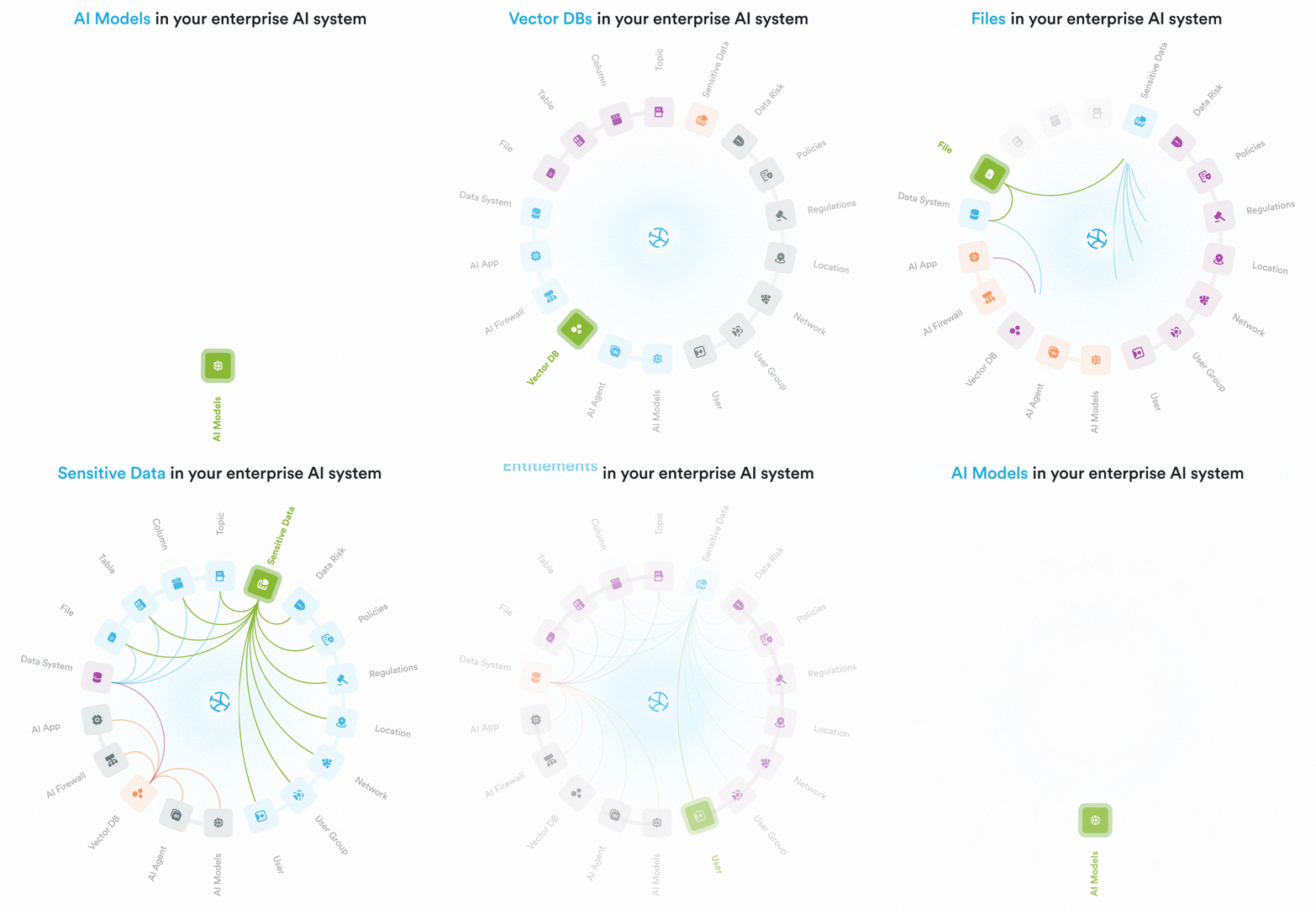
A GenAI system is often made up of a variety of building blocks and a myriad of complex relationships between ever changing data objects like files, user permissions, AI models, AI agents, vector databases, and user endpoints. It's important to have a full provenance view of the entire AI system, down to the level of each data object and file. Such visibility is also required by various AI regulations. Critical questions include: What data systems feed specific LLMs? Which files are being utilized? Who has access entitlements? What systems are impacted by vector database changes?

Gencore AI's proprietary knowledge graph provides granular contextual insights about data and AI systems within Databricks.

This enables real-time controls and comprehensive traceability across data usage, files, users, models, and endpoints.

Figure 5. DataAI Command Graph Provides Embedded Deep Visibility and Provenance for AI Systems

Typical Use Cases with Gencore AI and AI in Databricks

The support for Databricks' Mosaic AI and Delta Tables in Gencore AI enables enterprises to build safe, enterprise-grade AI systems that balance innovation with security and compliance. Key use cases include: 

1. Securely Ingest Data from Diverse Sources for AI Intelligence in Databricks

The solution enables comprehensive data ingestion into Databricks Delta Tables through secure data pipelines.

  • Seamlessly connect to on-premises databases, cloud storage platforms, SaaS applications (Salesforce, ServiceNow, Workday etc.), and on-premise data systems, enabling centralized data management in Delta Tables.
  • Leverage Securiti's DataAI Command Graph to automatically select relevant datasets based on business context, metadata, and compliance requirements.
  • Ensure data freshness, uniqueness, and topical relevance for high-quality inputs for AI model training and tuning.
  • Automatically sanitize both unstructured and structured data, including redaction, masking, and anonymization based on data sensitivity levels and organizational policies. 
  • Monitor data flows for adherence to privacy regulations, security policies, and data sovereignty requirements.

These capabilities establish a robust foundation for secure, compliant data operations that power the AI model training and tuning within the Mosaic AI ecosystem.

2. Provide Key Data Controls to Fuel the Scaled Use of Data + AI

The solution enables secure AI adoption at scale by implementing comprehensive governance controls and safeguards across AI and data systems, helping organizations confidently expand their AI capabilities while maintaining oversight.

  • Enable alignment with OWASP Top 10 for LLMs for Safe AI Systems. Provide graph-based full provenance view of AI+Data, as required for various AI regulations.
  • Enforce real-time data sanitization across AI pipelines in Databricks, automatically detecting and protecting sensitive information through masking and anonymization based on data classification policies.
  • Provide user entitlement and regulatory information on data ingested into Databricks, along with access and entitlement graphs for data in Databricks.
  • Provide LLM firewalls to ensure security and compliance with corporate controls on AI use, preventing prompt injection attacks, protecting against data leakage, and monitoring for adversarial inputs.

These controls enable organizations to scale enterprise AI initiatives while maintaining security, compliance, and governance requirements.

3. Building Personalized, Permissions-Aware AI Applications

Gencore AI provides a comprehensive framework for developing personalized, permissions-aware AI applications on the Databricks platform. The solution enables:

  • Development of context-aware AI applications that automatically adapt to each user's permissions and entitlements, ensuring employees only access and utilize AI features appropriate for their role and clearance level.
  • Seamless integration of enterprise data governance with AI workflows through automated access controls, real-time permissions validation, and granular audit logging - creating a foundation for responsible AI development.
  • Creation of personalized AI experiences by leveraging rich user metadata, interaction patterns, and historical usage data while maintaining strict security boundaries and compliance requirements.

This enterprise-grade approach allows organizations to build sophisticated, user-aware AI applications on Databricks while preserving security controls and regulatory compliance at scale.

At Securiti, our mission is to enable enterprises to safely harness the incredible power of data and AI. Gencore AI's support for Databricks' Mosaic AI and Delta Tables enables organizations to use their proprietary data for AI model development and deployment - from model training and fine-tuning to custom LLM creation and production inference. This integration helps organizations move quickly and safely from proof of concept to enterprise-grade AI systems.

Interested in seeing a demo? Submit a demo request at Gencore.AI.

Analyze this article with AI

Prompts open in third-party AI tools.
Join Our Newsletter

Get all the latest information, law updates and more delivered to your inbox


More Stories that May Interest You
Videos
View More
Rehan Jalil, Veeam on Agent Commander : theCUBE + NYSE Wired: Cyber Security Leaders
Following Veeam’s acquisition of Securiti, the launch of Agent Commander marks an important step toward helping enterprises adopt AI agents with greater confidence. In...
View More
Mitigating OWASP Top 10 for LLM Applications 2025
Generative AI (GenAI) has transformed how enterprises operate, scale, and grow. There’s an AI application for every purpose, from increasing employee productivity to streamlining...
View More
Top 6 DSPM Use Cases
With the advent of Generative AI (GenAI), data has become more dynamic. New data is generated faster than ever, transmitted to various systems, applications,...
View More
Colorado Privacy Act (CPA)
What is the Colorado Privacy Act? The CPA is a comprehensive privacy law signed on July 7, 2021. It established new standards for personal...
View More
Securiti for Copilot in SaaS
Accelerate Copilot Adoption Securely & Confidently Organizations are eager to adopt Microsoft 365 Copilot for increased productivity and efficiency. However, security concerns like data...
View More
Top 10 Considerations for Safely Using Unstructured Data with GenAI
A staggering 90% of an organization's data is unstructured. This data is rapidly being used to fuel GenAI applications like chatbots and AI search....
View More
Gencore AI: Building Safe, Enterprise-grade AI Systems in Minutes
As enterprises adopt generative AI, data and AI teams face numerous hurdles: securely connecting unstructured and structured data sources, maintaining proper controls and governance,...
View More
Navigating CPRA: Key Insights for Businesses
What is CPRA? The California Privacy Rights Act (CPRA) is California's state legislation aimed at protecting residents' digital privacy. It became effective on January...
View More
Navigating the Shift: Transitioning to PCI DSS v4.0
What is PCI DSS? PCI DSS (Payment Card Industry Data Security Standard) is a set of security standards to ensure safe processing, storage, and...
View More
Securing Data+AI : Playbook for Trust, Risk, and Security Management (TRiSM)
AI's growing security risks have 48% of global CISOs alarmed. Join this keynote to learn about a practical playbook for enabling AI Trust, Risk,...

Spotlight Talks

Spotlight 00:00
AI Agents Unleashed? The Future of Identity & Data Access Security
Watch Now View
Spotlight 00:00
IDC Research: Why Data, AI, Identity and Access Security Must Come Together
Watch Now View
Spotlight 59:11
Data Controls for AI: Findings from the 2026 GigaOm DSPM Research
Watch Now View
Spotlight 1:02:06
Consent by proxy: When AI agents start deciding for us
Watch Now View
Spotlight 1:00:41
Future-Proofing for the Privacy Professional
Watch Now View
Spotlight 50:52
From Data to Deployment: Safeguarding Enterprise AI with Security and Governance
Watch Now View
Spotlight 11:29
Not Hype — Dye & Durham’s Analytics Head Shows What AI at Work Really Looks Like
Watch Now View
Spotlight 11:18
Rewiring Real Estate Finance — How Walker & Dunlop Is Giving Its $135B Portfolio a Data-First Refresh
Watch Now View
Spotlight
Choosing the Right DSPM: An Industry Analyst’s Perspective
Watch Now View
Spotlight 13:38
Accelerating Miracles — How Sanofi is Embedding AI to Significantly Reduce Drug Development Timelines
Sanofi Thumbnail
Watch Now View
Latest
KSA PDPL in 2026 View More
KSA PDPL in 2026: What Organizations Need to Know Now
KSA's Personal Data Protection Law (PDPL) has been fully enforceable since 14th September 2024. Over the past two years, organizations have been navigating overlapping...
EU Digital Sovereignty View More
EU Digital Sovereignty is Moving from Policy to Procurement: What Organizations Need to Know
Digital sovereignty in Europe is moving from policy ambition toward something much more concrete: a framework that can determine how cloud services are assessed,...
View More
What Is Unstructured Data Discovery? A Practical Guide
Unstructured data discovery finds sensitive data in files, chats, and cloud storage. Securiti explains how it works, common challenges, and best practices.
Data Anonymization View More
What Is Data Anonymization
What is data anonymization? Securiti’s latest blog explains how it works, key techniques, and how it differs from pseudonymization. Read to learn more.
Saudi PDPL Compliance Toolkit View More
Saudi PDPL Compliance Toolkit
Turn Saudi PDPL requirements into action with practical checklists, a maturity self-assessment, and a 90-day plan for privacy and compliance leaders.
From Compliance to Continuous Assurance View More
From Compliance to Continuous Assurance: The Next Era of Saudi Data Protection
PDPL compliance didn’t end with the deadline. Learn how to comply with SDAIA enforcement requirements, govern cross-border transfers, and prepare your data for AI.
Data Minimization, Data Minimization for AI, Safe AI, AI Readiness, ROT Data, AI Governance, Data Governance, Data and AI Security, AI Risk Management, Sensitive Data View More
Minimize Before You Scale
Discover why redundant, obsolete, and trivial (ROT) data raises AI-era risks and how to minimize them. Explore practical fixes and business outcomes.

The PDPL Operational Lifecycle View More
The PDPL Operational Lifecycle
Find it. Fix it. Prove it. Repeat. Explore the 10-stage PDPL operational lifecycle, key deadlines, and the evidence regulators expect.
View More
Take the Data Risk Out of AI
Learn how to prepare enterprise data for safe Gemini Enterprise adoption with upstream governance, sensitive data discovery, and pre-index policy controls.
View More
Navigating HITRUST: A Guide to Certification
Securiti's eBook is a practical guide to HITRUST certification, covering everything from choosing i1 vs r2 and scope systems to managing CAPs & planning...
What's
New