Cookie Consent Meets Agentic Automation: Understanding Why Consent Agent Matters

Author

Muhammad Faisal Sattar

Sr. Manager, Product Legal & Global Data Compliance

FIP, CIPT, CIPM, CIPP/Asia

Listen to the content

Consider what consent management actually entails when a company operates across multiple markets. The website count varies, a thousand domains for some organizations, a dozen for others, but the complexity does not. Each geography demands its own banner behavior: opt-in across the EU, opt-out models in most US states, hybrid configurations where a single domain serves users under both. Each banner has to speak the right framework for its audience: TCF for European ad tech, Global Privacy Control for several US states, and Google Consent Mode wherever Google tags run. And underneath all of it, marketing and analytics teams keep shipping: new pixels, new tags, new vendors, added to live sites every week, almost never with a privacy review first.

Standing that up correctly is real work. Keeping it correct is harder, because every site is a moving target: a tracker fires before consent, a TC string comes back malformed, a GPC signal goes unanswered. The rules were never the hard part. What almost no team has, whether it manages a thousand domains or ten, is the bandwidth to verify every banner, tracker, and signal on every domain, every day. That is not a knowledge gap. It is an operation and scaling gap.

This is exactly the kind of problem agentic automation exists for: work that follows rules a machine can hold, at a scale no team can, with judgment routed to a human only where it is genuinely required. Consent Agent brings that model to Securiti's CMP through three stages: it builds the right banner for each geography, assesses it against 20+ compliance tests across the frameworks that apply, and remediates, fixing what is safe to fix automatically and escalating what needs a human. Consent Agent’s regulatory context is driven by Securiti's Consent Regulatory Database, which covers all out-of-the-box cookie consent templates for more than 80 jurisdictions, consent requirements, detailed cookie guidelines, and case laws related to key cookie consent concepts.

Three Agentic steps, not a checklist

Most Cookie consent compliance tooling stops at detection. It tells you something is wrong and leaves the fixing to you. A more useful model treats consent compliance as a closed loop with three stages: Build, Assess, Remediate.

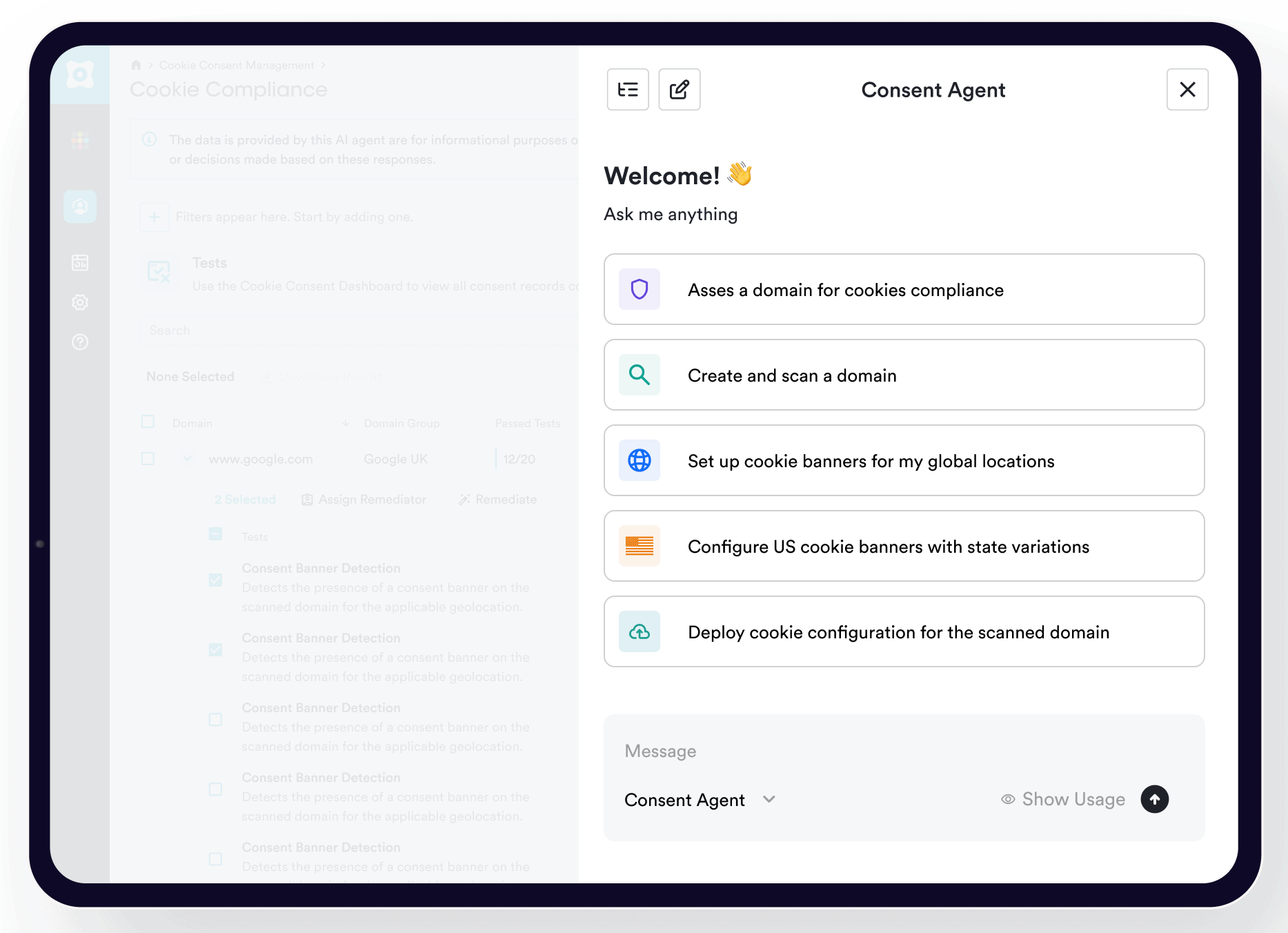
The Consent Agent interface: banner setup, domain scanning, and compliance testing in one guided workflow

  1. Build handles the setup work that used to eat the most hours. The system determines which banner type a jurisdiction actually requires, pulls branding straight from the live site, and configures the domain without someone hand-building a template for every region.
  2. Assess is where the rigor lives. Every domain runs through more than twenty automated compliance tests: banner correctness, pre-consent tracking, TC string validity, GPC signal handling, dark pattern detection, accessibility, and privacy policy completeness. This is the part that matters most to get right, because a test suite is only as good as the judgment behind it. Each check maps to the actual legal requirement it is testing for, not a generic best-practice guess, and every result comes back as pass, fail, NA, with jurisdiction-aware risk scoring and a confidence score attached, so a vacy program team can tell the difference between definitely broken and worth a second look. Every finding carries audit-ready evidence.
  3. Remediate closes the loop. The system recommends a fix for each finding, applies the ones that are safe to auto-remediate once approved, and hands over clear manual guidance for anything that genuinely needs a privacy team's eyes first. The system logs every action, both before and after.

Configuration does not stay put on its own

A banner that passes every test today does not necessarily pass next month. Domains change constantly: a marketing team adds a new pixel, a developer swaps a tag manager container, a third-party script starts firing before the consent gate loads. None of that shows up as a new violation in the traditional sense. It shows up as configuration drift, and drift is exactly what manual, point-in-time checks are worst at catching.

Continuous monitoring treats configuration as something to watch, not something to set once and file away. Every domain gets rescanned on a schedule, not only for the tests it failed last time but also for the full test suite, because a passing test can regress. When a new tracker fires pre-consent, when a banner's script starts loading before the CMP initializes, or when a jurisdiction's requirement changes and a banner falls out of date, the system flags it as a configuration issue tied to a specific test and a specific point in time, instead of an anomaly that someone has to happen to notice.

What changes when the compliance scans run continuously

The value does not come from any single one of those three steps. It comes from the fact that they run together on a schedule across every domain, rather than as a quarterly fire drill.

  1. Consent compliance stops being a manual, one-by-one process. Configuring banners per jurisdiction and chasing down issues used to be genuinely resource-intensive work. Compressing it into a guided, largely automated workflow changes what a small compliance team can realistically cover.
  2. Gaps stop hiding until it is too late. Pre-consent tracking, missing TC strings, GPC failures, these are the kinds of issues that sit quietly for months without continuous testing. Continuous testing means they do not get that long.
  3. Finding a problem and fixing it are no longer two separate projects. Most tools stop here, which is what is wrong. Closing the loop with a recommended fix, one-click approval, and automatic deployment is what actually reduces the backlog, rather than just documenting it.
  4. Proving compliance stops being a scramble. When a regulator or an internal audit asks for evidence, having before-and-after logs for every action already on file is the difference between a defensible answer and a scramble to reconstruct one.

Compliance Dashboard: Making compliance posture visible, not just logged

Running the tests is one half of it. The other half is being able to see, at a glance, where an organization actually stands across every framework and every domain, without pulling data from five different places.

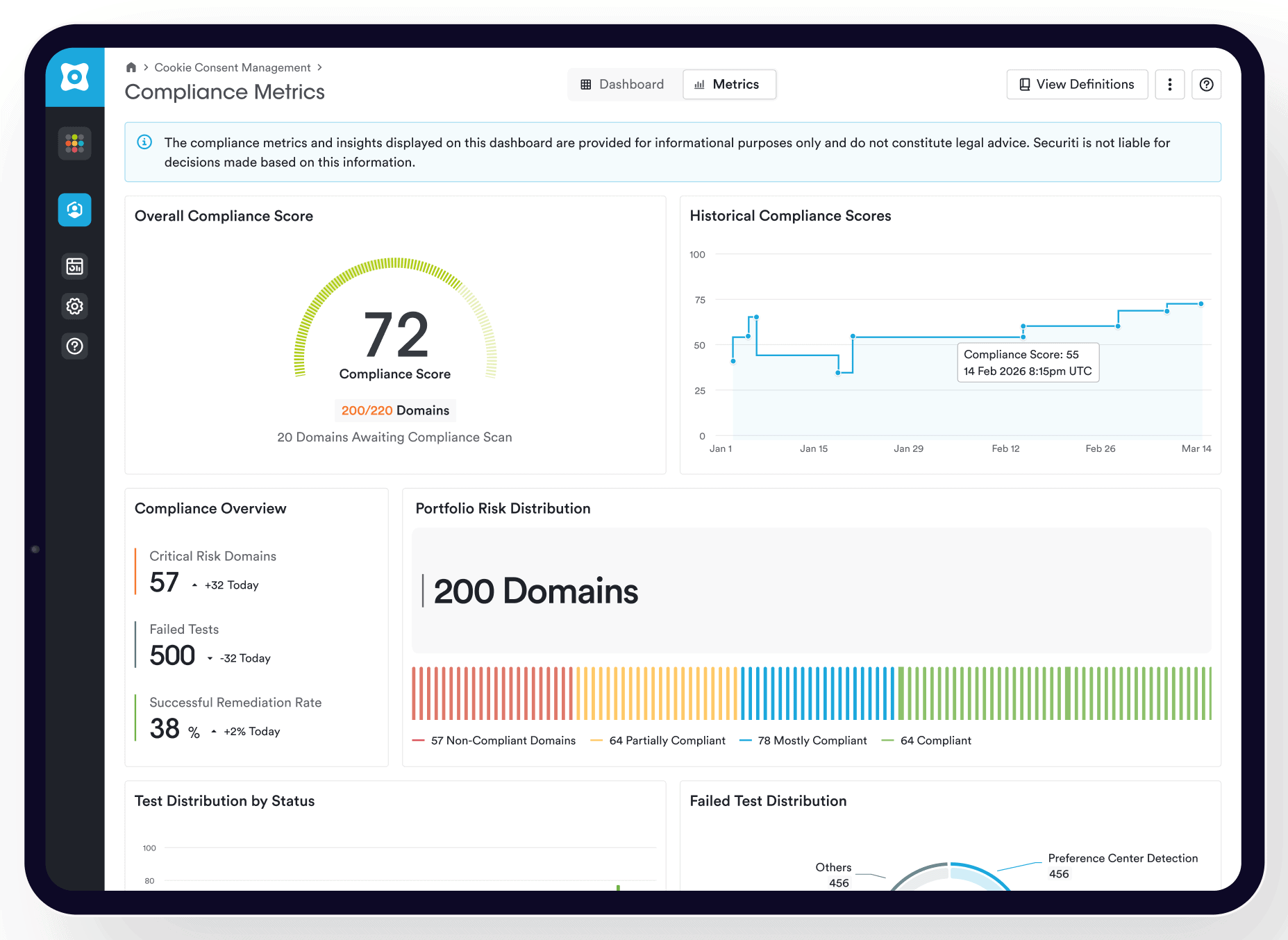
A centralized compliance dashboard makes that possible. Pre-built widgets surface pass and fail status across domains, tests, and frameworks, IAB (US and EU), Global Privacy Control, Google Consent Mode, GDPR, CCPA, and more, rolled into one aggregate score. Trend graphs turn point-in-time snapshots into an actual story: not just are we compliant today, but are we getting better, and how fast. A prioritized findings list links straight into the detail behind each issue, so a team can decide what to fix first instead of treating every finding as equally urgent. From there, a risk can be assigned to a remediator, accepted and excluded from future scans if it is genuinely out of scope, or tracked as part of a broader project with its own status and progress.


The compliance dashboard: aggregate score, historical trend, risk distribution, and remediation tracking in one view

That combination, real-time visibility plus historical trend, turns compliance reporting from a defensive exercise into something a legal or privacy team can actually bring to leadership and to regulators with confidence.

Why this matters beyond the tooling

None of this is really about automation for its own sake. It is about what becomes possible when a compliance program stops being reactive by default. Just-in-time alerts on high-severity risk mean a team responds to a problem in days, not at the next audit cycle. A defensible, timestamped record of every fix means the claim we take this seriously is backed by evidence instead of assurance.

The regulatory landscape around consent is not getting simpler. TCF requirements keep evolving, GPC enforcement is tightening, and the list of frameworks a global business has to satisfy keeps growing. The organizations that handle that well will not be the ones with the biggest compliance teams. They will be the ones whose compliance operations run continuously in the background, surface exactly what needs a human, and can prove it after the fact.

That is the shift worth paying attention to: not another tool that flags problems, but a system that closes the loop from detection to defensible fix, every day, across every domain. It is where Securiti's broader PrivacyOps platform is headed: agents built directly into the modules that already know the rules, so the rules get enforced continuously instead of periodically.

Analyze this article with AI

Prompts open in third-party AI tools.
Join Our Newsletter

Get all the latest information, law updates and more delivered to your inbox


More Stories that May Interest You
Videos
View More
Rehan Jalil, Veeam on Agent Commander : theCUBE + NYSE Wired: Cyber Security Leaders
Following Veeam’s acquisition of Securiti, the launch of Agent Commander marks an important step toward helping enterprises adopt AI agents with greater confidence. In...
View More
Mitigating OWASP Top 10 for LLM Applications 2025
Generative AI (GenAI) has transformed how enterprises operate, scale, and grow. There’s an AI application for every purpose, from increasing employee productivity to streamlining...
View More
Top 6 DSPM Use Cases
With the advent of Generative AI (GenAI), data has become more dynamic. New data is generated faster than ever, transmitted to various systems, applications,...
View More
Colorado Privacy Act (CPA)
What is the Colorado Privacy Act? The CPA is a comprehensive privacy law signed on July 7, 2021. It established new standards for personal...
View More
Securiti for Copilot in SaaS
Accelerate Copilot Adoption Securely & Confidently Organizations are eager to adopt Microsoft 365 Copilot for increased productivity and efficiency. However, security concerns like data...
View More
Top 10 Considerations for Safely Using Unstructured Data with GenAI
A staggering 90% of an organization's data is unstructured. This data is rapidly being used to fuel GenAI applications like chatbots and AI search....
View More
Gencore AI: Building Safe, Enterprise-grade AI Systems in Minutes
As enterprises adopt generative AI, data and AI teams face numerous hurdles: securely connecting unstructured and structured data sources, maintaining proper controls and governance,...
View More
Navigating CPRA: Key Insights for Businesses
What is CPRA? The California Privacy Rights Act (CPRA) is California's state legislation aimed at protecting residents' digital privacy. It became effective on January...
View More
Navigating the Shift: Transitioning to PCI DSS v4.0
What is PCI DSS? PCI DSS (Payment Card Industry Data Security Standard) is a set of security standards to ensure safe processing, storage, and...
View More
Securing Data+AI : Playbook for Trust, Risk, and Security Management (TRiSM)
AI's growing security risks have 48% of global CISOs alarmed. Join this keynote to learn about a practical playbook for enabling AI Trust, Risk,...

Spotlight Talks

Spotlight 59:11
Data Controls for AI: Findings from the 2026 GigaOm DSPM Research
Watch Now View
Spotlight 1:02:06
Consent by proxy: When AI agents start deciding for us
Watch Now View
Spotlight 1:00:41
Future-Proofing for the Privacy Professional
Watch Now View
Spotlight 50:52
From Data to Deployment: Safeguarding Enterprise AI with Security and Governance
Watch Now View
Spotlight 11:29
Not Hype — Dye & Durham’s Analytics Head Shows What AI at Work Really Looks Like
Watch Now View
Spotlight 11:18
Rewiring Real Estate Finance — How Walker & Dunlop Is Giving Its $135B Portfolio a Data-First Refresh
Watch Now View
Spotlight
Choosing the Right DSPM: An Industry Analyst’s Perspective
Watch Now View
Spotlight 13:38
Accelerating Miracles — How Sanofi is Embedding AI to Significantly Reduce Drug Development Timelines
Sanofi Thumbnail
Watch Now View
Spotlight 10:35
There’s Been a Material Shift in the Data Center of Gravity
Watch Now View
Spotlight 14:21
AI Governance Is Much More than Technology Risk Mitigation
Watch Now View
Latest
Australia’s Office of AI: Why Annual Audits Miss What Your AI Can Reach View More
Australia’s Office of AI: Why Annual Audits Miss What Your AI Can Reach
Picture this: a fictional but entirely plausible scenario. An Australian financial institution's AI systems spend six months accessing a customer data repository nobody has...
View More
A Complete DSPM Needs Classification and Context
Classification is one of the core functions a DSPM program handles, and it usually runs in tandem with discovery, since together they form the...
View More
What Is Enterprise AI Security? A Beginner’s Guide
Learn what enterprise AI security is, why it matters, the key risks organizations face, and how to protect AI systems, agents, models, data, and...
View More
What is Data Transparency? Why it Matters for the Modern Enterprise
Learn what data transparency is, why it matters, and how organizations can improve visibility, accountability, governance, trust, and responsible data use.
View More
Privacy RFP Buyer’s Guide: 120+ Questions to Evaluate Privacy Automation Platforms
Download the Privacy RFP Buyer’s Guide with 120+ practical questions to evaluate privacy automation platforms across compliance, security, integrations, governance, and scalability.
View More
Green-Light AI, Not Data Exposure
Learn the five critical data-layer controls enterprises need to prevent sensitive data exposure and enable secure, scalable AI agent adoption.
The Toxic Combination Problem in DataAI Risks View More
The Toxic Combination Problem in DataAI Risks
Discover how siloed security alerts create hidden toxic risk combinations and how correlated context helps reduce alert fatigue and uncover compound risks faster.
The Cloud Storage Bill Nobody Reads View More
The Cloud Storage Bill Nobody Reads
Hidden cloud storage costs add up fast. Learn how redundant, obsolete, and trivial data drives unnecessary spend, expands risk, and why automated data minimization...
View More
Take the Data Risk Out of AI
Learn how to prepare enterprise data for safe Gemini Enterprise adoption with upstream governance, sensitive data discovery, and pre-index policy controls.
View More
Navigating HITRUST: A Guide to Certification
Securiti's eBook is a practical guide to HITRUST certification, covering everything from choosing i1 vs r2 and scope systems to managing CAPs & planning...
What's
New