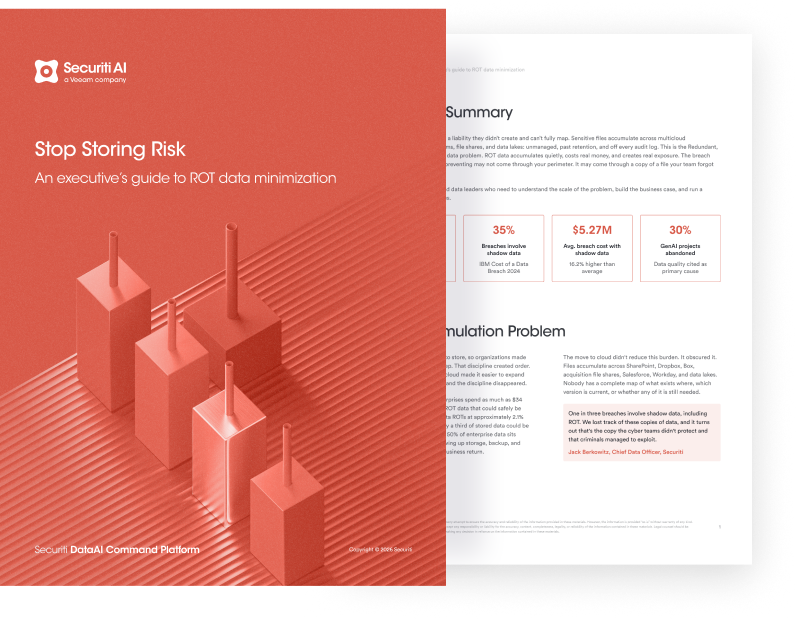
Redundant, obsolete, and trivial (ROT) data accumulates across on-prem systems, cloud storage, SaaS platforms, and file shares nobody has mapped. ROT data minimization is the practice of finding that data and minimizing it under policy. To put things into perspective, IBM's 2024 Cost of a Data Breach Report found that 35% of breaches involved data in unmanaged sources, costing USD 5.27 million on average. IBM's 2026 edition puts the global average at USD 4.99 million.
However, the exposure does not end at the attack surface. Obsolete and trivial data also degrade the AI projects enterprises fund, because a model treats whatever it ingests as current and reliable. For instance, a superseded policy sitting on an active SharePoint site can surface in an AI assistant's answer months after the legal team replaced it. Manual review doesn't close any of this, which is why most programs die in a million-row spreadsheet.
Here, ROT data minimization, built on automated discovery, context-aware data classification, and federated auto-remediation, can play a critical role in overcoming these challenges.
Download the whitepaper to learn how Securiti, a Veeam company, helps security and governance leaders discover, prioritize, and remediate ROT data at scale.