The Context Layer for Data+AI Security

How the DataAI Command Graph Connects What Isolated Findings Miss

In this whitepaper, you’ll learn about:

  • The critical need for a context layer beneath data, identity, cloud, and AI findings.
  • The top challenges that fragmented findings create range from slow breach-impact analysis to stalled AI adoption.
  • The core capabilities of the DataAI Command Graph are one model across all Data+AI assets.
  • The distinguishing features of toxic combination detection compared with single-signal alerting.

DOWNLOAD WHITE PAPER


Enterprise security teams have never produced more findings, and never had more difficulty ranking them. Data discovery, identity management, cloud posture, and AI inventories each return accurate results, yet none supply the context layer that explains how one finding relates to another. In fact, more than 20% of organizations reported a breach targeting their AI models or applications, according to IBM's 2026 Cost of a Data Breach Report. The leading causes were weaknesses in the surrounding systems: compromised APIs, applications, or plug-ins, and cloud misconfigurations affecting AI workloads.

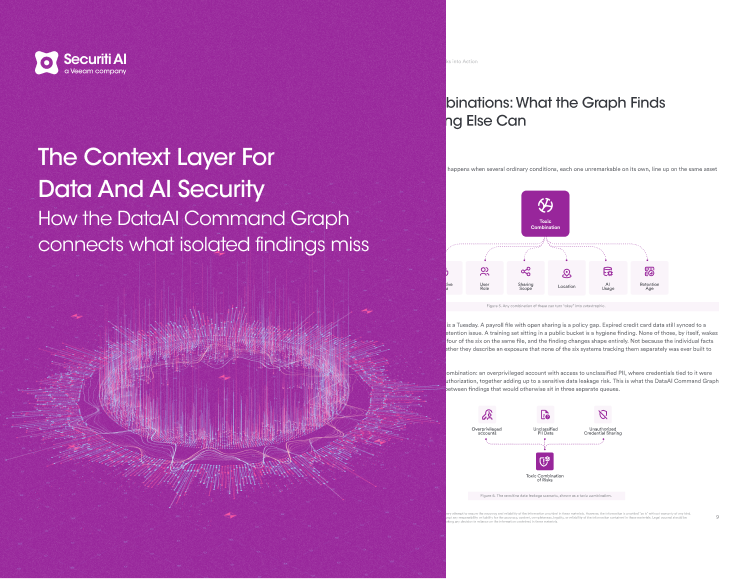
However, the harder problem is not the volume of findings but their isolation. Security, privacy, and governance teams report accurate numbers for the same environment and still disagree on what those numbers mean. For instance, an overprivileged account, unclassified PII, and an unauthorized credential share may sit in three queues as three medium-severity tickets. Together, they form one exposure nobody has seen whole.

Here, a shared context layer across data, identities, permissions, cloud resources, and AI assets can play a critical role in overcoming these challenges.

Download the whitepaper to learn how Securiti, a Veeam company, connects data, identity, cloud, and AI findings into one contextual model of risk.

 

The Context Layer for Data+AI Security

Award-winning technology, built by a proven team, backed by confidence. Learn more.


Frequently Asked Questions (FAQs)

A context layer connects data, identities, permissions, cloud resources, and AI assets in a shared model. It reveals how separate security findings relate, helping teams understand combined exposure rather than assess alerts in isolation.

Individual tools may accurately identify issues without showing how they connect. This fragmentation can hide exposure paths, slow breach-impact analysis, and leave security, privacy, and governance teams with conflicting interpretations of risk.

Single-signal alerting identifies individual issues. Toxic combination detection connects findings such as an overprivileged account, unclassified personal data, and unauthorized credential sharing to reveal a larger exposure that separate alerts may miss.

The DataAI Command Graph connects data, identity, cloud, and AI findings into one contextual model of risk. This shared view helps teams understand relationships between assets, permissions, and exposures and prioritize connected risks.

Shared context helps teams assess AI assets alongside the sensitive data, permissions, and surrounding systems they interact with. Understanding these relationships supports informed governance decisions and helps address security gaps that can stall AI deployment.

All-in-One Solution For Your Business Needs

The Multi-disciplinary practice to grow trust-equity of your brand and comply with privacy regulations

Privacy RFP Buyer’s Guide: 120+ Questions to Evaluate Privacy Automation Platforms

Download the Privacy RFP Buyer’s Guide with 120+ practical questions to evaluate privacy automation platforms across compliance, security, integrations, governance, and scalability.

Green-Light AI, Not Data Exposure

Learn the five critical data-layer controls enterprises need to prevent sensitive data exposure and enable secure, scalable AI agent adoption.

Agentic AI Readiness: Why Your Enterprise Needs a New Data Security Paradigm

Learn how to secure Agentic AI by discovering sensitive data, mitigating AI risks, and building an enterprise-ready AI security strategy.

Stop Letting Data Risk Stall Your Copilot Rollout

Learn how to safely scale Microsoft 365 Copilot with data labeling, ROT data minimization, and governance using Securiti's DataAI Command Platform.

DPDPA Compliance: A Practical Guide for Enterprises

Learn how to operationalize compliance with India's Digital Personal Data Protection Act (DPDPA) using automation for consent, data governance, security, vendor management, and data subject rights.

Transforming Privacy, Security, and AI Governance with a Unified Data Command Center

Discover how a unified Data Command Center enables data-first governance, automates compliance workflows, and improves privacy, security, and AI governance.

Over-Retention: The Problem on Every CISO’s Plate

Learn how BFSI organizations can enforce data minimization, reduce over-retention risks, and strengthen AI security with automated data discovery, classification, and remediation.

The Cost of Ungoverned Data in Financial Services

Discover how ROT data drives hidden security, compliance, and storage costs and learn how data minimization helps reduce risk and optimize spend.

The Cost of Ungoverned Data

Discover how automated ROT data minimization reduces security, compliance, AI, and storage risks with policy-driven governance and Securiti's built-in DSPM.

Privacy Leadership 2026: How CPOs Can Move from Compliance Owners to Trust Architects

Download the Privacy Leadership 2026 whitepaper to learn how CPOs can evolve from compliance owners to Trust Architects and build enterprise-wide trust.

See the platform live

Ready to see DataAI Command Platform in action?

See how your team can discover sensitive data, reduce risk, and secure AI usage from one command center.

Book a demo
Demo BG Book a demo
Videos
View More
Rehan Jalil, Veeam on Agent Commander : theCUBE + NYSE Wired: Cyber Security Leaders
Following Veeam’s acquisition of Securiti, the launch of Agent Commander marks an important step toward helping enterprises adopt AI agents with greater confidence. In...
View More
Mitigating OWASP Top 10 for LLM Applications 2025
Generative AI (GenAI) has transformed how enterprises operate, scale, and grow. There’s an AI application for every purpose, from increasing employee productivity to streamlining...
View More
Top 6 DSPM Use Cases
With the advent of Generative AI (GenAI), data has become more dynamic. New data is generated faster than ever, transmitted to various systems, applications,...
View More
Colorado Privacy Act (CPA)
What is the Colorado Privacy Act? The CPA is a comprehensive privacy law signed on July 7, 2021. It established new standards for personal...
View More
Securiti for Copilot in SaaS
Accelerate Copilot Adoption Securely & Confidently Organizations are eager to adopt Microsoft 365 Copilot for increased productivity and efficiency. However, security concerns like data...
View More
Top 10 Considerations for Safely Using Unstructured Data with GenAI
A staggering 90% of an organization's data is unstructured. This data is rapidly being used to fuel GenAI applications like chatbots and AI search....
View More
Gencore AI: Building Safe, Enterprise-grade AI Systems in Minutes
As enterprises adopt generative AI, data and AI teams face numerous hurdles: securely connecting unstructured and structured data sources, maintaining proper controls and governance,...
View More
Navigating CPRA: Key Insights for Businesses
What is CPRA? The California Privacy Rights Act (CPRA) is California's state legislation aimed at protecting residents' digital privacy. It became effective on January...
View More
Navigating the Shift: Transitioning to PCI DSS v4.0
What is PCI DSS? PCI DSS (Payment Card Industry Data Security Standard) is a set of security standards to ensure safe processing, storage, and...
View More
Securing Data+AI : Playbook for Trust, Risk, and Security Management (TRiSM)
AI's growing security risks have 48% of global CISOs alarmed. Join this keynote to learn about a practical playbook for enabling AI Trust, Risk,...

Spotlight Talks

Spotlight 59:11
Data Controls for AI: Findings from the 2026 GigaOm DSPM Research
Watch Now View
Spotlight 1:02:06
Consent by proxy: When AI agents start deciding for us
Watch Now View
Spotlight 1:00:41
Future-Proofing for the Privacy Professional
Watch Now View
Spotlight 50:52
From Data to Deployment: Safeguarding Enterprise AI with Security and Governance
Watch Now View
Spotlight 11:29
Not Hype — Dye & Durham’s Analytics Head Shows What AI at Work Really Looks Like
Watch Now View
Spotlight 11:18
Rewiring Real Estate Finance — How Walker & Dunlop Is Giving Its $135B Portfolio a Data-First Refresh
Watch Now View
Spotlight
Choosing the Right DSPM: An Industry Analyst’s Perspective
Watch Now View
Spotlight 13:38
Accelerating Miracles — How Sanofi is Embedding AI to Significantly Reduce Drug Development Timelines
Sanofi Thumbnail
Watch Now View
Spotlight 10:35
There’s Been a Material Shift in the Data Center of Gravity
Watch Now View
Spotlight 14:21
AI Governance Is Much More than Technology Risk Mitigation
Watch Now View
Latest
Australia’s Office of AI: Why Annual Audits Miss What Your AI Can Reach View More
Australia’s Office of AI: Why Annual Audits Miss What Your AI Can Reach
Picture this: a fictional but entirely plausible scenario. An Australian financial institution's AI systems spend six months accessing a customer data repository nobody has...
View More
A Complete DSPM Needs Classification and Context
Classification is one of the core functions a DSPM program handles, and it usually runs in tandem with discovery, since together they form the...
View More
DSPM for AI: Extending Data Posture to Prompts, Pipelines & Agents
Learn how DSPM for AI helps enterprises discover sensitive data, assess exposure, govern access, reduce risk, and secure data before AI systems and agents...
DSPM vs DLP: Key Data Security Differences Explained View More
DSPM vs DLP: Key Data Security Differences Explained
Compare DSPM vs DLP to understand how they differ in data discovery, classification, monitoring, prevention, risk reduction, and protecting sensitive enterprise data.
The Context Layer for Data+AI Security View More
The Context Layer for Data+AI Security
Discover how Securiti’s DataAI Command Graph connects data, identity, cloud, and AI findings to uncover contextual risk and toxic combinations.
View More
Privacy RFP Buyer’s Guide: 120+ Questions to Evaluate Privacy Automation Platforms
Download the Privacy RFP Buyer’s Guide with 120+ practical questions to evaluate privacy automation platforms across compliance, security, integrations, governance, and scalability.
The Toxic Combination Problem in DataAI Risks View More
The Toxic Combination Problem in DataAI Risks
Discover how siloed security alerts create hidden toxic risk combinations and how correlated context helps reduce alert fatigue and uncover compound risks faster.
The Cloud Storage Bill Nobody Reads View More
The Cloud Storage Bill Nobody Reads
Hidden cloud storage costs add up fast. Learn how redundant, obsolete, and trivial data drives unnecessary spend, expands risk, and why automated data minimization...
View More
Take the Data Risk Out of AI
Learn how to prepare enterprise data for safe Gemini Enterprise adoption with upstream governance, sensitive data discovery, and pre-index policy controls.
View More
Navigating HITRUST: A Guide to Certification
Securiti's eBook is a practical guide to HITRUST certification, covering everything from choosing i1 vs r2 and scope systems to managing CAPs & planning...
What's
New