Announcing Agent Commander - The First Integrated solution from Veeam + Securiti.ai enabling the scaling of safe AI agents

View

The Future of Data Privacy Under The New Administration

Published January 20, 2021
Author

Omer Imran Malik

Data Privacy Legal Manager, Securiti

FIP, CIPT, CIPM, CIPP/US

Listen to the content

Global data privacy laws and regulations have been evolving for several years. These privacy laws have come a long way from sectoral guidelines, local regulations, and laws to comprehensive national-level legislation that applies extraterritorially. Many of these laws are enforceable by dedicated regulatory agencies (Attorney general of California enforcing the CCPA), which can levy significant fines and other penalties (such as class action lawsuits) for non-compliance.

In the United States, there is a patchwork of state laws, industry-led guidelines, and sectoral legislation that govern data privacy. Some of these laws include the CCPA, Nevada Senate Bill 220, the Maine Act, NYCRR, and many more.

In the last three years, The three most notable additions/changes to data privacy laws in the U.S. were:

  1. CCPA goes into effect
  2. CPRA amendments
  3. SCHREMS-II verdict

However, without an overarching federal data privacy law, average citizens’ data continues to be at risk.

Is a Federal Data Privacy Law a Potential Reality?

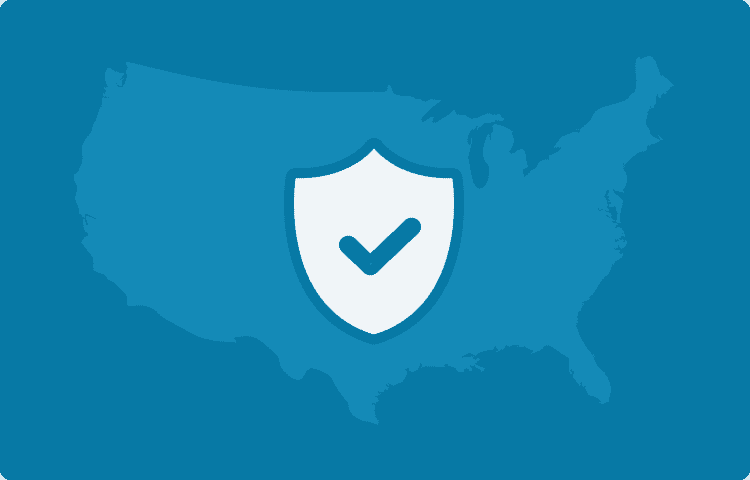
It is anticipated that the new administration could pursue a federal privacy regulation. Vice President-elect Kamala Harris has shown interest in privacy-related topics during her career as California Attorney General and U.S. Senator. Being a strong proponent of data privacy, Vice-President Harris is expected to encourage President Biden to sign a federal data privacy bill if it gets passed in the House and Senate. With a single party leading the government’s legislative and executive branches, a Federal Privacy bill could soon become law.

As mentioned in the National Law Review article, during her tenure as California Attorney General, Kamala Harris actively promoted data privacy in California. In January 2013, her office issued a report named (Privacy on the Go: Recommendations for the Mobile Ecosystem). This report encourages tech giants like Amazon, Apple, Google, Hewlett-Packard, Microsoft, Research In Motion, and Facebook, that process vast amounts of consumer data, to be responsible custodians of this data. Ms. Harris also created the Privacy Enforcement and Protection Unit of the California Attorney General’s Office. This unit was tasked to enforce identity theft, cybersecurity, and data breach laws. Currently, the Privacy Enforcement and Protection Unit (PEPU) is responsible for enforcing the California Consumer Privacy Act.

Federal-level legislation covering all U.S. states will help close any loopholes that individual state laws might have open. A federal privacy law would also make it easier for data processors to organize and consolidate compliance efforts as they won’t be required to follow different state regulations.

The new administration will also take steps to address the EU and U.S.’s transatlantic data transfers after the EU-U.S. Privacy Shield was invalidated by the CJEU last year. The SCHREMS-II decision was in light of  U.S. intelligence agencies’ expansive and unaccountable data surveillance practices. Experts predict that the new administration will negotiate with the EU to deliver a revised cross-border data transfer law. Since the Federal Trade Commission is responsible for enforcing data privacy laws, experts believe that the Biden Administration will empower the Federal Trade Commission (FTC) to enforce privacy regulations.

In addition to data privacy, cybersecurity is also a significant topic of discussion among the new administration officials. In light of the recent cyber-attacks on the U.S. government, the new administration is expected to prioritize measures to prevent future cyber attacks.

Are States taking steps to enact their own Data Privacy Legislation?

In case the federal government fails to enact a Federal Privacy law, U.S. states are likely to implement their own data privacy legislation. The National Law Review has extracted a few quotes from Pollyanna Sanderson, policy counsel with the Future of Privacy Forum, an organization lobbying for more robust data privacy protections.

"In the states, we've seen a huge acceleration in understanding and interest in how privacy works in a technical sense and a willingness to do more," said Sanderson.

U.S. states such as  Washington and New York are taking a cue from California to craft their own state data privacy laws. It is expected that even if a federal data privacy law is implemented, it may not preempt stricter state laws - allowing state legislation to continue to remain relevant.

"Nearly half of the states introduced privacy bills in the first half of 2020. That was all put on hold due to  COVID-19. But these laws are likely to return into consideration as the vaccine begins to roll out and the world returns to business as usual," said Sanderson.

Conclusion

A federal data privacy law will bring a stronger foundation for managing data privacy in the U.S. and safeguard consumers’ personal information. A few predictions for the next four years:

  1. A Federal level Data Privacy legislation is signed into law.
  2. There will be stricter regulations and enforcement of regulations on data privacy.
  3. There will be Privacy law enforcement by an empowered FTC.
  4. Updates to SCHREMS-II decision, making transatlantic data transfers easier.
  5. Cyber Security Leaders will improve cybersecurity processes that safeguard critical data at public and private institutions.
Your Data+AI Command Center

Enable Safe Use of Data and AI

Analyze this article with AI

Prompts open in third-party AI tools.
Join Our Newsletter

Get all the latest information, law updates and more delivered to your inbox


Share

More Stories that May Interest You
Videos
View More
Rehan Jalil, Veeam on Agent Commander : theCUBE + NYSE Wired: Cyber Security Leaders
Following Veeam’s acquisition of Securiti, the launch of Agent Commander marks an important step toward helping enterprises adopt AI agents with greater confidence. In...
View More
Mitigating OWASP Top 10 for LLM Applications 2025
Generative AI (GenAI) has transformed how enterprises operate, scale, and grow. There’s an AI application for every purpose, from increasing employee productivity to streamlining...
View More
Top 6 DSPM Use Cases
With the advent of Generative AI (GenAI), data has become more dynamic. New data is generated faster than ever, transmitted to various systems, applications,...
View More
Colorado Privacy Act (CPA)
What is the Colorado Privacy Act? The CPA is a comprehensive privacy law signed on July 7, 2021. It established new standards for personal...
View More
Securiti for Copilot in SaaS
Accelerate Copilot Adoption Securely & Confidently Organizations are eager to adopt Microsoft 365 Copilot for increased productivity and efficiency. However, security concerns like data...
View More
Top 10 Considerations for Safely Using Unstructured Data with GenAI
A staggering 90% of an organization's data is unstructured. This data is rapidly being used to fuel GenAI applications like chatbots and AI search....
View More
Gencore AI: Building Safe, Enterprise-grade AI Systems in Minutes
As enterprises adopt generative AI, data and AI teams face numerous hurdles: securely connecting unstructured and structured data sources, maintaining proper controls and governance,...
View More
Navigating CPRA: Key Insights for Businesses
What is CPRA? The California Privacy Rights Act (CPRA) is California's state legislation aimed at protecting residents' digital privacy. It became effective on January...
View More
Navigating the Shift: Transitioning to PCI DSS v4.0
What is PCI DSS? PCI DSS (Payment Card Industry Data Security Standard) is a set of security standards to ensure safe processing, storage, and...
View More
Securing Data+AI : Playbook for Trust, Risk, and Security Management (TRiSM)
AI's growing security risks have 48% of global CISOs alarmed. Join this keynote to learn about a practical playbook for enabling AI Trust, Risk,...

Spotlight Talks

Spotlight 50:52
From Data to Deployment: Safeguarding Enterprise AI with Security and Governance
Watch Now View
Spotlight 11:29
Not Hype — Dye & Durham’s Analytics Head Shows What AI at Work Really Looks Like
Watch Now View
Spotlight 11:18
Rewiring Real Estate Finance — How Walker & Dunlop Is Giving Its $135B Portfolio a Data-First Refresh
Watch Now View
Spotlight 13:38
Accelerating Miracles — How Sanofi is Embedding AI to Significantly Reduce Drug Development Timelines
Sanofi Thumbnail
Watch Now View
Spotlight 10:35
There’s Been a Material Shift in the Data Center of Gravity
Watch Now View
Spotlight 14:21
AI Governance Is Much More than Technology Risk Mitigation
Watch Now View
Spotlight 12:!3
You Can’t Build Pipelines, Warehouses, or AI Platforms Without Business Knowledge
Watch Now View
Spotlight 47:42
Cybersecurity – Where Leaders are Buying, Building, and Partnering
Rehan Jalil
Watch Now View
Spotlight 27:29
Building Safe AI with Databricks and Gencore
Rehan Jalil
Watch Now View
Spotlight 46:02
Building Safe Enterprise AI: A Practical Roadmap
Watch Now View
Latest
View More
Introducing Agent Commander
The promise of AI Agents is staggering— intelligent systems that make decisions, use tools, automate complex workflows act as force multipliers for every knowledge...
Risk Silos: The Biggest AI Problem Boards Aren’t Talking About View More
Risk Silos: The Biggest AI Problem Boards Aren’t Talking About
Boards are tuned in to the AI conversation, but there’s a blind spot many organizations still haven’t named: risk silos. Everyone agrees AI governance...
Largest Fine In CCPA History_ What The Latest CCPA Enforcement Action Teaches Businesses View More
Largest Fine In CCPA History: What The Latest CCPA Enforcement Action Teaches Businesses
Businesses can take some vital lessons from the recent biggest enforcement action in CCPA history. Securiti’s blog covers all the important details to know.
View More
AI & HIPAA: What It Means and How to Automate Compliance
Explore how the Health Insurance Portability and Accountability Act (HIPAA) applies to Artificial Intelligence (AI) in securing Protected Health Information (PHI). Learn how to...
View More
From Data Visibility to AI Velocity
Access the whitepaper and discover how unified DataAI security turns data governance into a business enabler, boosting AI innovation with visibility, compliance, and risk...
View More
EU Data Act Implementation Guide: Handling Data Access, Data Sharing, & Cloud Switching Requests
Securiti's whitepaper provides a detailed implementation guide to achieve Data Act compliance, making it essential reading for businesses operating with data in the EU.
Compliance with CCPA Amendments with Securiti View More
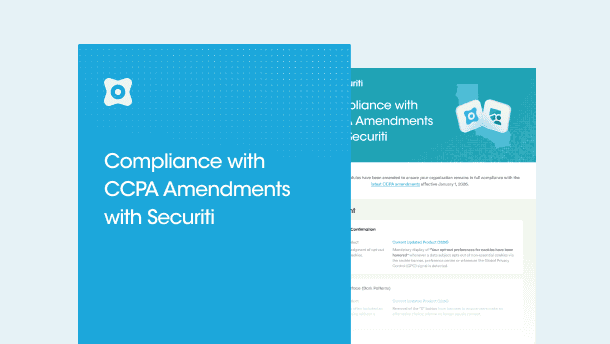
Compliance with CCPA Amendments with Securiti
Stay compliant with 2026 CCPA amendments using Securiti, covering updated consent requirements, expanded sensitive data definitions, enhanced consumer rights, and readiness assessments.
View More
Where Privacy Breaks: Agentic AI in the Enterprise
Agentic AI is transforming enterprises, but at what cost to privacy? Discover the top 10 risks, key controls, and how Securiti enables safe, scalable...
View More
Take the Data Risk Out of AI
Learn how to prepare enterprise data for safe Gemini Enterprise adoption with upstream governance, sensitive data discovery, and pre-index policy controls.
View More
Navigating HITRUST: A Guide to Certification
Securiti's eBook is a practical guide to HITRUST certification, covering everything from choosing i1 vs r2 and scope systems to managing CAPs & planning...
What's
New